
Exhibition marketing: 2027 industrial fair calendar and how to prepare
An industrial trade show does not begin when the exhibition hall opens or end when the stand is dismantled. We look at Spain’s main industrial trade fairs confirmed for 2027 and how to approach marketing before, during and after the event to generate real opportunities.
There is a moment that feels very familiar at almost any industrial trade show.
It is around ten in the morning. The carpet still smells new, someone is finishing arranging the catalogues that arrived the night before, the coffee machine is already being pushed beyond its limits and the team is looking down the aisle, waiting for people to appear.
We have a stand.
We have products.
We have five people ready to talk to visitors.
And then comes the awkward question: who exactly do we want to walk down that aisle?
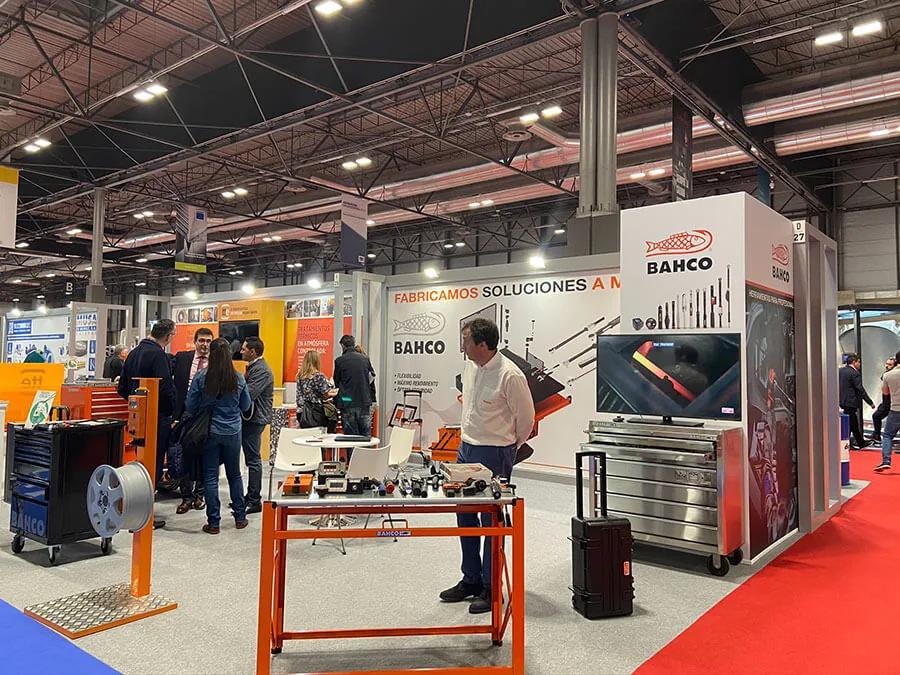
Taking part in a trade show is not a marketing strategy.
It is a channel. An expensive, intense and, when used properly, extraordinarily useful one for certain B2B and industrial businesses.
The difference between «being at a trade show» and doing trade show marketing lies precisely there: in everything that happens before the doors open and after someone starts dismantling the lights. Good exhibition marketing is mostly work that happens when the hall is empty.
In 2027, Spain will once again host important events in advanced manufacturing, automation, automotive, packaging, logistics, maritime industries and healthcare technology. But before booking floor space, there is something more important to consider than the size of the stand.
What do we actually want to happen because of this trade show?
Industrial trade fairs in Spain confirmed for 2027
This calendar was updated on 8 September 2026 and only includes events whose 2027 edition and dates we have verified on the organiser's own website. We make that distinction because trade fair calendars change, some events are biennial and others have not yet announced their next edition.
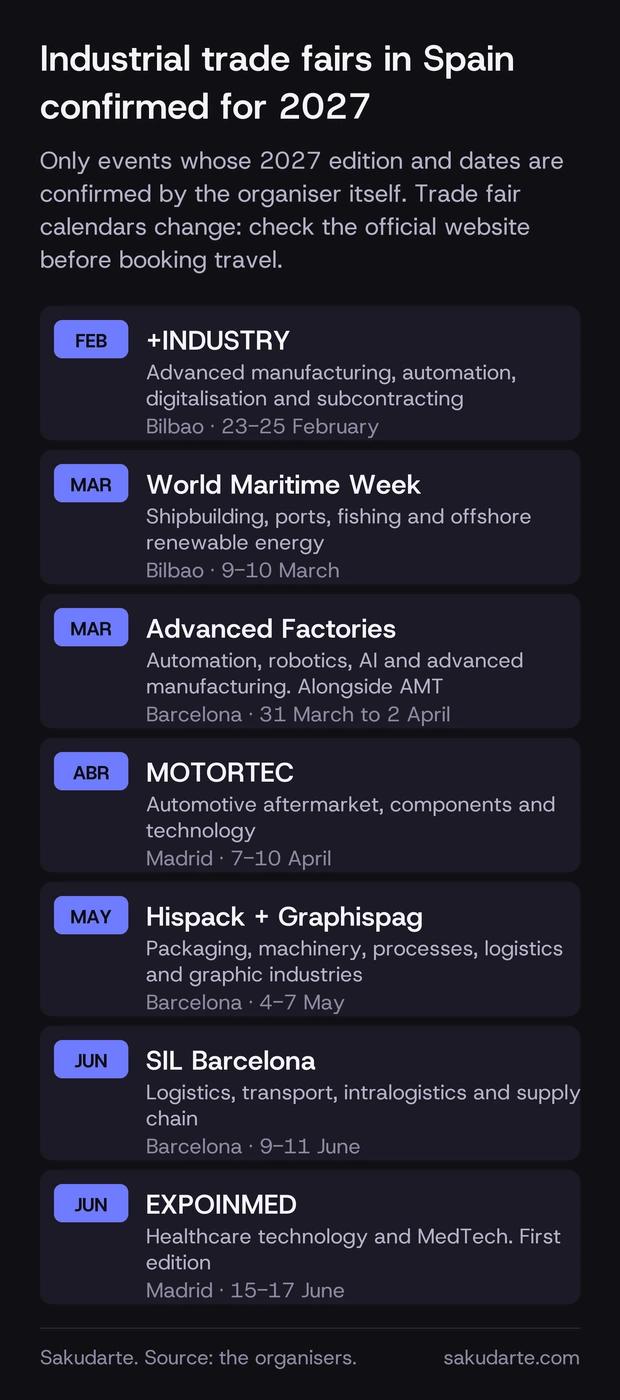
- +INDUSTRY — advanced manufacturing, automation, digitalisation and subcontracting. Bilbao, 23-25 February 2027.
- World Maritime Week — shipbuilding, ports, fishing and offshore renewable energy. Bilbao, 9-10 March 2027.
- Advanced Factories — automation, robotics, AI and advanced manufacturing. Barcelona, 31 March to 2 April 2027.
- MOTORTEC — automotive aftermarket, components and technology. Madrid, 7-10 April 2027.
- Hispack + Graphispag — packaging, machinery, processes, logistics and graphic industries. Barcelona, 4-7 May 2027.
- SIL Barcelona — logistics, transport, intralogistics and supply chain. Barcelona, 9-11 June 2027.
- EXPOINMED — healthcare technology and MedTech. Madrid, 15-17 June 2027.
These dates have been confirmed by the organisers at the time of publication, but if an event forms part of your 2027 commercial plan, it is always worth checking the official website again before booking travel, accommodation or associated activities.
+INDUSTRY 2027 — Bilbao, 23-25 February
Bilbao Exhibition Centre will once again bring together several events related to advanced manufacturing under +INDUSTRY. That is worth reading carefully: it is not one trade fair but seven running in parallel, each with its own name —Additi3D, BeDIGITAL, Maintenance, Pumps & Valves, Subcontratación and weAR— plus the WORKinn talent forum. BEC has confirmed the event for 23 to 25 February 2027 and positions it as one of Spain's major meeting points for smart manufacturing.
Being seven has a practical consequence: you book a stand in one of them, and that choice is already a marketing decision. Different profiles from across the value chain come together in the same environment, which creates opportunities and increases the noise at the same time.
Turning up with a generic message such as «solutions for industry» is probably not the best way to be remembered.
World Maritime Week — Bilbao, 9-10 March
Also at BEC, World Maritime Week will hold its sixth edition on 9 and 10 March 2027, bringing together four areas of the maritime economy: shipbuilding, fishing, ports and offshore renewable energy.
It is a good example of a trade show where message specialisation matters enormously. Even if a company works across several of these sectors, a shipyard, a port operator and an offshore wind project do not necessarily arrive with the same problems or look for the same arguments.
Same event.
Not necessarily the same conversation.
Advanced Factories — Barcelona, 31 March to 2 April
Advanced Factories will hold its eleventh edition from 31 March to 2 April 2027 at Fira Barcelona – Gran Via, focusing on industrial automation, robotics, artificial intelligence and technologies linked to the transformation of manufacturing, together with the Industry 4.0 Congress and several specialist forums. The organisers expect more than 36,000 professionals and 770 exhibiting companies.
One detail that changes who you should send: in 2027 it runs alongside AMT (Advanced Machine Tools). If your customer is in machine tools, the same trip covers two distinct audiences; and if they are not, it is worth knowing that some of the visitors are there looking for something else.
This also brings us to a familiar challenge in technology-focused exhibition marketing: everyone talks about innovation.
AI. Automation. Industry 4.0. Digitalisation.
When twenty stands use the same vocabulary, technology alone stops being a differentiator.
Perhaps the question before the event should not be which technology we are going to show, but which specific problem we want someone to associate with us when they return to their company.
MOTORTEC — Madrid, 7-10 April
MOTORTEC 2027 will take place at IFEMA Madrid from 7 to 10 April, once again bringing together the automotive aftermarket value chain: manufacturers, distributors, workshops, spare parts, diagnostics, commercial vehicles, tyres and technology, among other areas.
The expected scale is considerable. IFEMA announced in July 2026 a forecast of 725 participating companies and around 66,800 visitors for the 2027 edition, across more than 100,000 m² spread over six halls.
The bigger the event, the more important the work done beforehand becomes.
Hoping that the right people will simply stumble across us somewhere among six exhibition halls is certainly one strategy.
Buying a lottery ticket is another.
We prefer booking meetings.
Hispack + Graphispag — Barcelona, 4-7 May
Hispack will celebrate its twentieth edition from 4 to 7 May 2027 at Fira Barcelona Gran Via and will once again run alongside Graphispag, which will occupy Hall 1 while Hispack spreads across Halls 2 and 3. The event will cover packaging, machinery and processes, labelling, bottling, automation, robotics, logistics and industrial packaging, together with technologies from the graphic industries.
Hispack expects to exceed 900 exhibitors, 10% more than in 2024, and to strengthen its cross-sector focus across food and beverage, chemicals, cosmetics, pharmaceuticals, automotive and industrial goods.
That cross-sector nature creates a particularly interesting opportunity for pre-event campaigns by segment.
The company may only have one stand.
The messages do not have to be identical for every market.
SIL Barcelona — Barcelona, 9-11 June
SIL Barcelona has confirmed its twenty-ninth edition for 9 to 11 June 2027. The event focuses on logistics, transport, intralogistics and supply chain, with a strong emphasis on business, knowledge exchange and international networking.
The previous edition closed with 15,412 visitors from 87 countries and more than 600 participating companies, 30% of them international.
But the most interesting fact for a marketing plan is not the attendance figure: in 2027 SIL becomes the «Logistics Innovation Show», a change the organisers justify by the arrival of artificial intelligence, automation, robotics and data analysis, with a format that asks companies to demonstrate applied innovation rather than display it.
That is worth pausing on.
If the organiser itself changes the premise of the event, arriving with last year's pitch means sitting out the conversation they are about to start. The physical trade show stopped beginning at the entrance to the hall a long time ago, and it stopped being a display cabinet even more recently.
EXPOINMED — Madrid, 15-17 June
EXPOINMED will hold its first edition from 15 to 17 June 2027 at IFEMA Madrid, run jointly with Medicina Responsable. It is a new professional event focused on medical innovation and healthcare technology, covering areas such as robotic surgery, AI applied to healthcare, advanced therapies, digital health, imaging and diagnostics, and innovative pharmacy.
A first edition introduces a different variable.
There is no historical event data to rely on yet.
That means companies need to assess more carefully how closely their market matches the visitor profile the organisers aim to attract, but it can also create an opportunity for brands that want to establish an early position within a new sector meeting point.
Trade show marketing starts before you book the stand
A stand can be booked many months before an event.
Curiously, the strategy often starts much later.
The space is reserved, someone requests a stand design quote, the question appears about which machine we should bring and somebody starts debating whether we need one hundred or five hundred catalogues.
All of that matters.
But we still have not answered the fundamental question.
What result would justify the investment?
It could be opening distribution in France, securing meetings with ten target accounts, launching a new product, reconnecting with international customers, entering a new sector, identifying partners or generating a certain volume of commercial opportunities.
Each objective changes the marketing.
If we want to win ten major accounts, perhaps the main KPI should not be how many people visited the stand, but how many of those ten companies sat down with us.
If we are launching a product, pre-event communication needs to create interest and explain why someone should dedicate twenty minutes of an already overloaded schedule to meeting us.
And if the objective is to strengthen customer relationships, much of the value may come from meetings that will never appear in the report as «new leads».
The trade show should not define the objective.
The objective should define how we use the trade show.
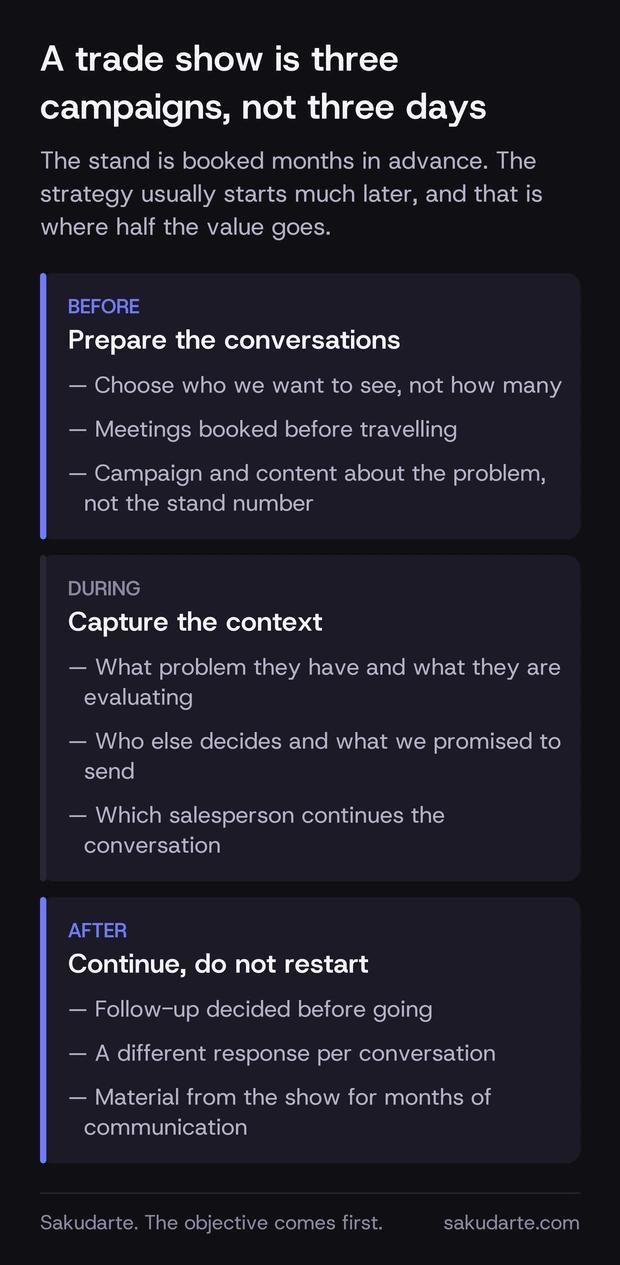
Before the event: do not wait for people to find you while walking around
The traditional image of exhibition marketing is to build an impressive stand and attract passing traffic.
That can work.
But it leaves far too much to chance.
The weeks before the event create a better opportunity: working on the companies and people we genuinely want to meet.
We can identify priority accounts, review current customers, open opportunities and former contacts, analyse who will be exhibiting or attending, and coordinate with sales on which conversations are worth starting before the event.
Marketing can prepare the ground.
A dedicated landing page can explain what we will be presenting and make it easier to book meetings. LinkedIn can help build recognition before the event. A B2B advertising campaign can focus on accounts or profiles related to the fair. Salespeople can work on personal invitations, while B2B content marketing can explore the specific problem we plan to discuss face-to-face.
Not everyone needs to receive the same email announcing:
«See you in Hall 4, Stand D37!»
That matters much more to us than it does to the recipient.
The useful question is why someone should reserve thirty minutes at a trade show full of alternatives to talk to our company.
Once we can answer that, the stand number can come later.
The stand matters, but it cannot carry the whole strategy
Of course, the physical space matters.
A trade show is one of the few places where an industrial brand can be built at full scale: product, people, demonstrations, lighting, materials, sound and movement.
Some machines need to be seen in operation.
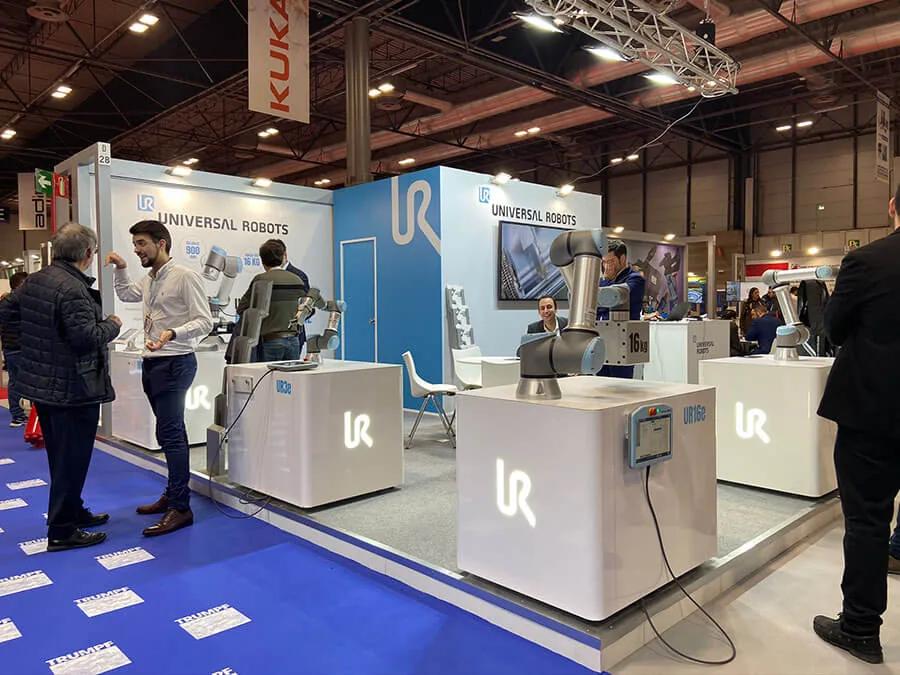
Some products need to be touched.
Some processes are much easier to understand standing in front of a component than through a twenty-page PDF.
But stand design should begin with the conversation we want to facilitate.
Do we need to exhibit products, or do we need space for meetings? Do we want to demonstrate a technology? Do we have to handle several different visitor profiles at the same time? What should someone understand in the five seconds it takes them to walk past?
The most spectacular stand does not always generate the most interesting conversations.
Sometimes the opposite happens: we build a small corporate cathedral that everyone photographs but where nobody quite knows where to sit down and talk.
A brand needs enough impact to be recognised.
After that, it needs to help business happen.
During the event: scanning a badge does not mean generating an opportunity
Trade shows create a misleading sense of activity.
Everyone is talking.
People keep arriving.
We scan badges.
We hand out documents.
We finish the day without a voice and go to dinner convinced it was a success because «we didn't stop all day».
Maybe it was.
Or maybe we were simply very busy.
The problem appears a week later, when someone opens the database and finds 284 contacts accompanied by nothing more than a name, company and email address.
What did we discuss with Laura?
Was Roberto's company looking for a supplier, or was he trying to sell something to us?
Who said they had a project planned for September?
This is where a significant amount of trade show value disappears.
Capturing a contact is relatively easy. Capturing the context matters far more.
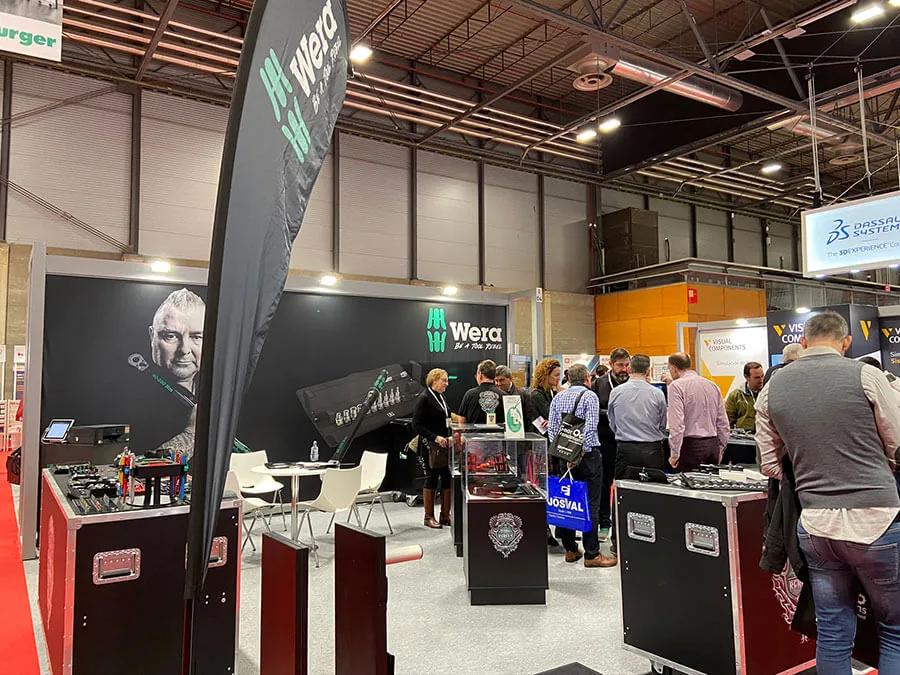
What problem do they have? What solution are they evaluating? Who else is involved? What material did we promise to send? When would it make sense to talk again? Which salesperson should continue the conversation?
Technology can help capture this information, summarise notes or synchronise it with the CRM.
But someone still needs to ask the right question first.
After the event is when we discover whether we really had a plan
On Friday, the stand is dismantled.
On Monday, the company returns to normal.
And one of the biggest leaks in exhibition marketing performance appears.
Contacts wait.
The sales team has a backlog of meetings.
Marketing starts preparing the next campaign.
And a few days later, a generic email goes out:
«Thank you very much for visiting us at the trade show.»
To 200 people.
Among them was probably one of the best opportunities of the year.
Follow-up should be designed before attending the event.
Not every conversation requires the same response. Some need a proposal. Others need technical documentation. Perhaps two teams need to be connected, a demonstration needs to be prepared, a similar case study should be sent or a conversation simply needs to be scheduled three months later.
The difference lies in using the information collected at the event to continue the context rather than restarting the conversation from the beginning.
A good trade show leaves you with work to do.
If on Monday we do not know what to do with what happened, the problem probably started well before Monday.
How do we know whether a trade show worked?
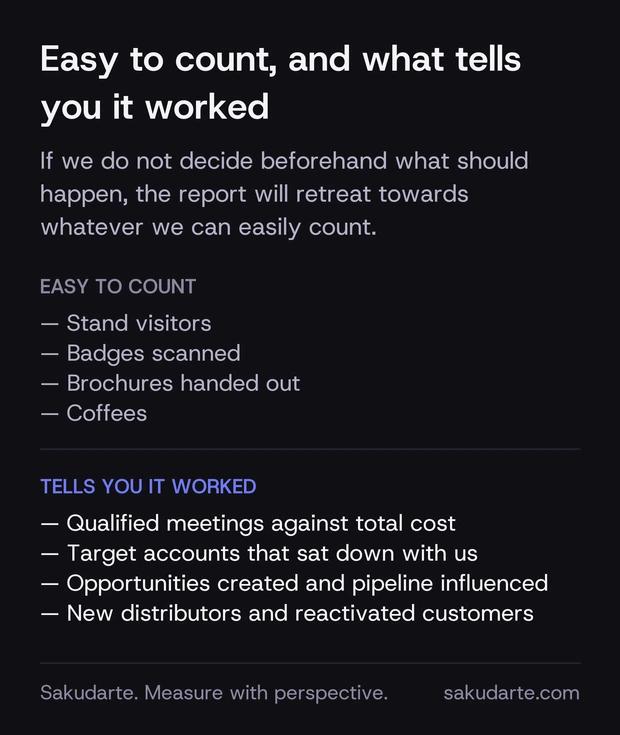
Counting stand visitors can be useful.
Counting opportunities is usually more useful.
The difficulty is that in B2B, many deals do not close within two weeks of the event. A trade show in February may influence a project that finally converts in November and that, in the meantime, has involved another eight interactions.
That does not mean we cannot measure it.
It means we need enough perspective.
We can compare the total participation cost with qualified meetings, opportunities created, target accounts contacted, pipeline generated or influenced, new distributors, reactivated customers and deals eventually won.
There are also less immediate returns.
A trade show may give us the chance to record demonstrations, interview experts, produce original photography, collect genuine market questions or see how competitors are presenting their offers.
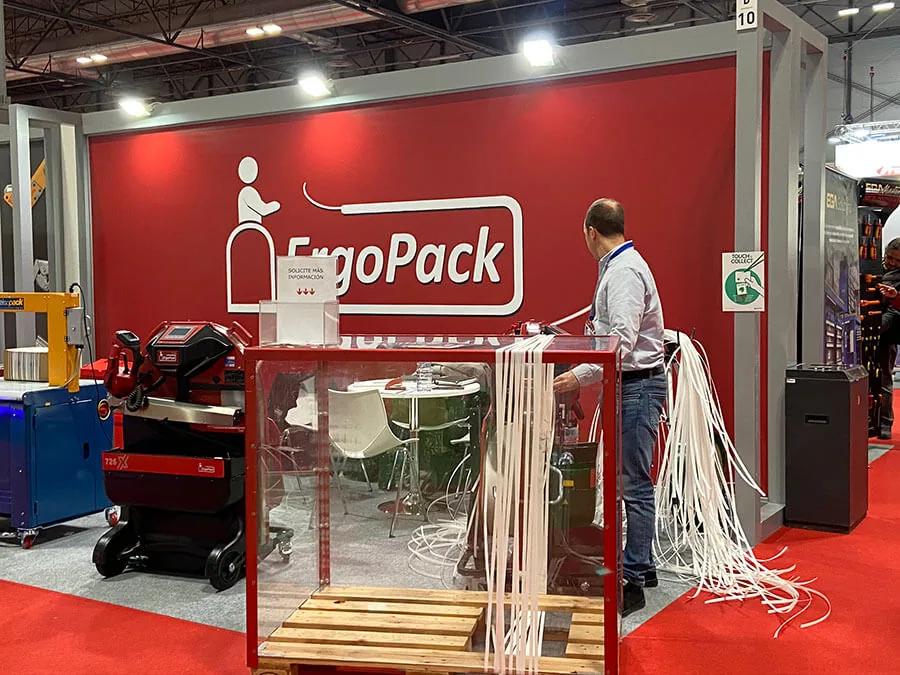
Some of that material can fuel months of communication.
The important thing is to decide beforehand which results we expect to observe.
If we do not know what needs to happen for the event to be considered worthwhile, the post-event report will naturally retreat towards the things we can easily count.
Visitors.
Scans.
Brochures.
Coffees.
All true.
Not necessarily business.
The trade show should be part of the marketing plan, not live in a separate calendar
In many industrial companies, trade shows have their own budget, their own calendar and almost a life of their own.
Marketing does certain things throughout the year.
And «the trade shows» are something else.
That separation is becoming less useful.
A trade show can concentrate into three days many of the things we pursue for months: visibility, content, relationships, demonstrations, sales conversations, market intelligence and customer contact.
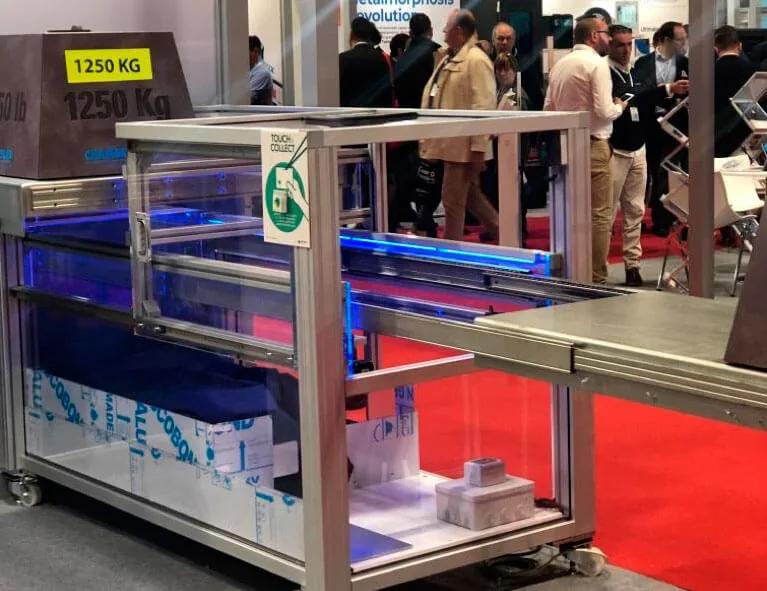
That is why it should be integrated into the B2B marketing strategy and connected with campaigns, content, the website, sales and the CRM. In industrial marketing, the trade show is still one of the few channels where product, people and a commercial conversation share the same square metre, and that makes it far too valuable to manage on its own.
In the weeks before the event, we can generate demand and book meetings.
During the event, we can turn digital interest into human conversations.
Afterwards, we can turn those conversations into opportunities and content.
That is when trade show marketing starts to make sense.
Not as stand design.
Not as a few social posts announcing that we will be there.
But as a campaign with a before, a during and an after.
So, which trade show should we attend in 2027?
Not necessarily the biggest one.
Nor the one «we have always attended».
Not even the one with the greatest number of companies from our sector.
We would choose the event with a good concentration of the companies, profiles and conversations that form part of our strategy.
That may mean exhibiting.
It may mean sponsoring a conference.
Or it may simply mean attending as visitors with an agenda of fifteen carefully prepared meetings.
There are even years when the best exhibition marketing decision may be not to build a stand at all.
That is strategy too.
The 2027 calendar is already taking shape: Bilbao will concentrate much of the advanced manufacturing and maritime activity at the beginning of the year; Barcelona will bring together automation, packaging and logistics between spring and summer; and Madrid will host relevant events in automotive and healthcare technology.
The interesting question is not how many we can squeeze into the calendar.
It is which ones give us something relevant enough to say, and who it is genuinely worth saying it to.
If you want to see what that looks like in practice, our B2B marketing case studies include work where the trade show was one piece of a campaign rather than the event of the year.
Because the exhibition hall will be full of stands.
The opportunity lies in arriving with the conversations already half started.