
B2B SEO agency for industrial and technical companies
In B2B, almost nobody searches for what you call your product. They search for the problem, the application or the standard they have to meet. SEO starts there, not in a keyword list.
Search visibility for a buyer who is comparing suppliers
We treat SEO as part of the strategy, not as a layer added at the end. First we decide which market and which profile we want to reach; then, which terms actually reach them.
The goal is not traffic. It is for SEO to help you:
- Show up when someone describes the problem your product solves, even if they do not use your vocabulary.
- Reach both the people who decide and the people who influence, who search for different things at different moments.
- Hold positions on low-volume, high-intent terms, which are the ones that bring real opportunities in industrial markets.
Keyword research with measured volume
No term enters the plan without verified volume and without checking who holds its top ten. If the answer is business schools or tool vendors, that term is not yours, however many searches it has.
Content architecture
Pages by service, by sector and by application, each able to answer on its own. In B2B almost nobody arrives through the home page.
Technical SEO
Speed, indexing, structured data, redirects and internal architecture. The part nobody sees, and the one that decides whether the rest is worth anything.
Visibility in AI search
Content and markup prepared so that ChatGPT, Gemini or Perplexity can interpret and cite what you do.
Industrial SEO: why it looks nothing like consumer SEO
Industrial SEO works with small volumes. Where a shop fights over terms with a hundred thousand monthly searches, here a query with ninety can be worth more than anything else, because it is made by exactly the twenty people who can buy from you.
That changes the criterion. A high-volume term with the wrong audience is not an opportunity: it is a source of sales work that gets discarded. It has happened to us while measuring: we have dropped terms with thirteen hundred monthly searches because their first page was full of business schools, not industrial companies.
It also changes the content. Industrial buyers arrive with technical judgement, compare suppliers and look for evidence: certifications, real applications, tolerances, lead times. Persuasive copy without data does not move them; a well-structured datasheet does.
And it changes the timeframe. With buying cycles measured in months, SEO is not judged by next month’s visits but by whether the enquiries coming in look more like what you want to sell.
SEO for manufacturers and industrial companies: what actually gets done
First, the vocabulary. There is almost always a gap between how a company names what it does and how its customers search for it. Closing it is not about picking synonyms: it is deciding which language you want to be found by, and holding it across the whole site.
Then, the structure. A company with five product lines and four application sectors does not get ranked with a single «products» page: every relevant combination needs its own place, its own term and its own reason to exist.
And finally, the proof. In industrial markets authority is not bought with directory links: it is built by publishing what you know in a form somebody else can cite. It is slow, and it is the only thing that lasts.



A B2B SEO agency you can check before hiring
When someone looks for a B2B SEO agency, almost every website says the same things. We would rather you checked ours.
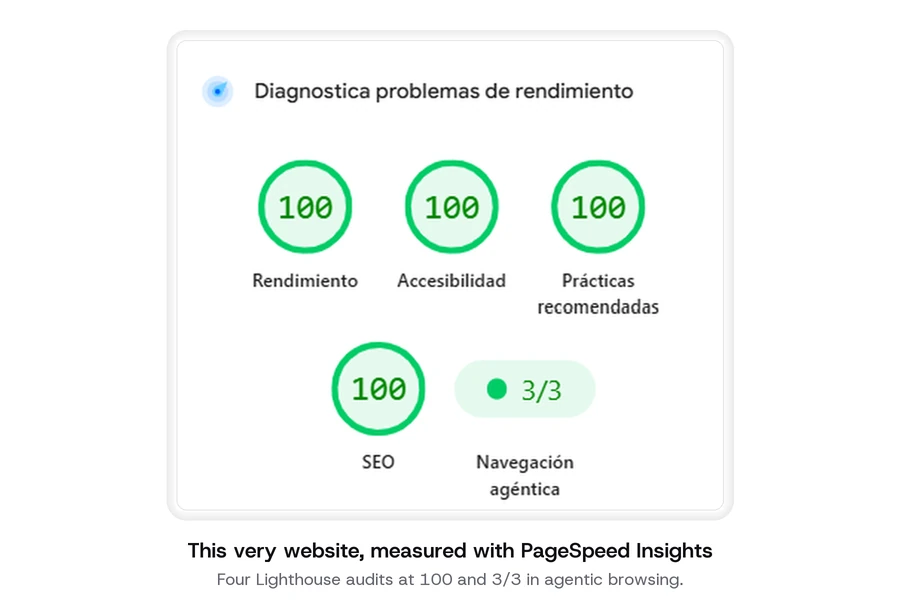
This very page you are reading scores 100 out of 100 across the four PageSpeed Insights audits —performance, accessibility, best practices and SEO— and 3/3 in agentic browsing. It is static HTML, with no heavy templates or surplus plugins. It is not a promise: it is a link you can open right now and verify yourself.
The side of this that works on visibility inside AI-generated answers we handle separately, under AI SEO, because there the measure of success is no longer a position but whether you get cited.
And if you are curious how you get there, we tell it with the figures in our article on moving off WordPress, including what we cannot measure.
SEO inside the B2B Marketing System
Search visibility does not work on its own
SEO needs a website that can hold what it brings. It needs content that answers real questions, and a brand that explains why you are worth considering once the visitor has arrived. Without that, ranking only means more people see the same thing.
That is why we work on search visibility inside a B2B Marketing System, with the strategy decided beforehand and measurement connected to the business afterwards. A good month of traffic is not a result; a commercial opportunity is.
If your customers search for what you do and find somebody else…
We can measure where you stand, which terms are worth it and what it takes to get there.
Start by knowing what your customers search for
Request a quoteReal cases from industrial B2B companies













 to a trustworthy offer for healthcare centres.


From designing packaging that works on the shelf to a commercial and digital strategy that turns creative value into business.
+

From several independent industrial lines to an engineering group with a shared story, structure and presence.
+

From manufacturing and distributing quality-control instruments to a system to organise identity, catalogues and international expansion.
+
From a Lean methodology that needed to stand out to a brand with authority, content and a digital strategy.
+
From a fast-growing intralogistics engineering firm to a brand system ready to integrate new companies.
+

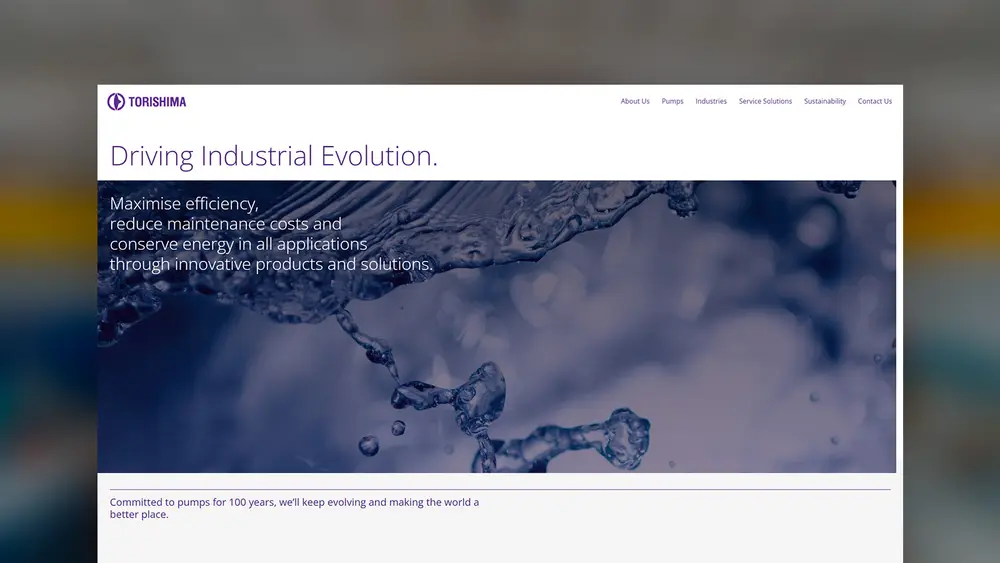
From a global industrial pump engineering firm to a digital presence that organises solutions, sectors and services.
+Frequently asked questions about B2B and industrial SEO
What is B2B SEO and how does it differ from ordinary SEO?
B2B SEO aims to rank a company in front of other companies, not consumers. That changes three things: volumes are much smaller but intent is much higher, several people decide using different criteria, and the buying cycle lasts months. In practice it means chasing terms with tens or hundreds of searches and an exact fit, instead of massive terms with a mixed audience.
How long does SEO take to produce results for an industrial company?
It depends on the starting point, the domain authority and the competition for each term, but in industrial B2B it is better to count in quarters than in weeks. The first position movements usually show between the second and fourth month; turning that into commercial opportunities takes longer, because the buying cycle is long to begin with. In exchange, positions won with technical content tend to be fairly stable.
What role does SEO play in a website for industrial companies?
SEO helps an industrial company be visible when its clients search for solutions, suppliers, technical applications or specialised information. An optimised website must work on keywords, content structure, service pages, useful content, technical performance and topical authority.
What content helps position a B2B company in search engines?
The content that most helps position a B2B company is service pages, sector pages, success stories, technical articles, comparison guides, answers to frequently asked questions, product sheets, content about real applications and pages that explain specific client problems.
Is it better to chase high-volume or high-intent terms?
In industrial B2B, almost always high-intent ones. A term with ninety monthly searches made only by purchasing managers in your sector is worth more than one with a thousand made by students, browsers and companies of another profile. The way to tell them apart is not volume: it is looking at who holds its first page today. If they are schools, general media or tool vendors, that term will not bring clients even if you win it.
What is GEO or Generative Engine Optimization?
GEO, or Generative Engine Optimization, means preparing content to increase the chances of appearing in AI-generated answers and conversational search engines. To do that, a website must offer clear answers, structured information, expert content, verifiable data and messages that are easy to interpret.
How can a website appear more often in AI search?
To improve its presence in AI-assisted search, an industrial website must answer specific questions, structure its pages well, explain services and capabilities precisely, include useful technical information, work on use cases and demonstrate experience through clear, reliable content.
Do we need to rebuild the website to work on SEO?
Not always, but there is a limit. On a slow, badly structured or unextendable site, SEO turns into fighting the website itself. The usual approach is to start by auditing what can be fixed on what exists —speed, structure, content, redirects— and only propose a new site when repairing it costs more than building it.
When it does need rebuilding, we approach it through B2B web design.
How do you measure whether SEO is working?
With the positions and impressions of the terms we decided to chase, not with total traffic, which rises and falls for reasons we do not control. And above all by looking downstream: what kind of companies arrive, how many enquiries come in and how many of those look like what you want to sell. If traffic goes up and opportunities do not move, the problem was not visibility.