
8 changes redefining how industry buys
Industrial buyers research independently, use more channels and rarely make decisions alone. We look at eight changes transforming B2B marketing and what they mean for manufacturers, engineering firms and technology and agri-food companies.
For years, many industrial companies built their marketing around a fairly simple logic: manufacture well, have a strong sales network, attend the key trade fairs and wait for the market to do the rest.
It was not necessarily a bad strategy. In many sectors, it worked for decades.
What has changed is not that commercial relationships have stopped mattering, or that purchasing managers have decided to replace their suppliers with a sequence of forms and algorithms. What has changed is everything that happens before, during and around that sales conversation.
Customers now carry out more research on their own, consult different sources, use artificial intelligence, compare suppliers before making contact and share the decision with more people inside their organisation. At the same time, when they need to validate information, reduce risk or justify a major investment, they still need people capable of providing judgement and context.
In this environment, B2B industrial marketing has much less to do with "doing advertising" and much more to do with understanding how a complex decision is actually made.
These are eight changes we think are worth paying attention to.
1. Industrial buyers research independently before they want to speak to you
For years, one figure was repeated constantly: 57% of the B2B buying process was supposedly completed before a buyer contacted sales. It became so popular that it almost turned into a law of marketing.
Today we have much more recent data and, above all, a more nuanced picture.
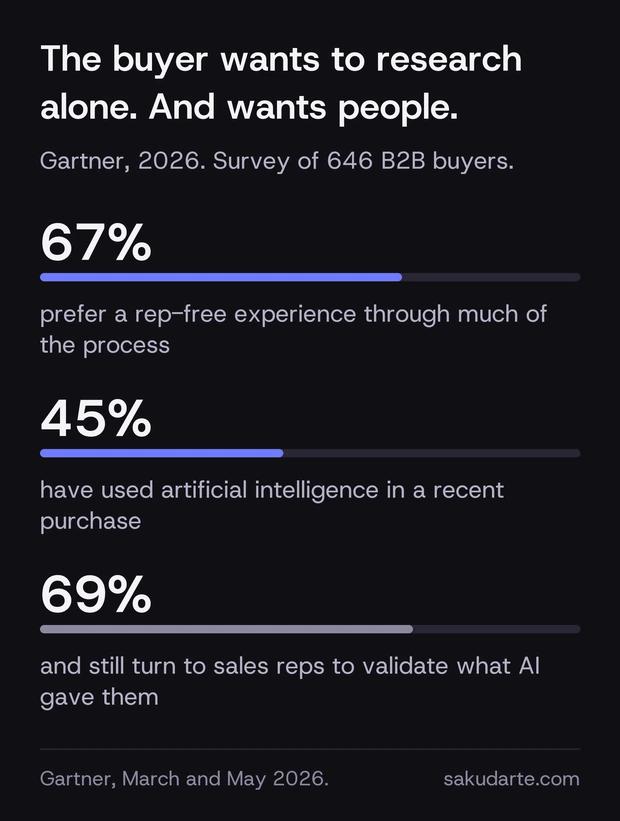
In March 2026, Gartner published research involving 646 B2B buyers in which 67% said they preferred a rep-free experience for much of the buying process. In addition, 45% had used artificial intelligence during a recent purchase, mainly to research suppliers and solutions.
That does not mean salespeople have stopped being important. Two months later, Gartner found that 69% of buyers preferred to turn to sales professionals to validate information obtained through AI. Buyers want to research independently, but they still rely on people when they need context, confidence or help making an important decision.
That distinction matters.
The sales team no longer necessarily controls the beginning of the conversation. By the time an enquiry arrives, a potential customer may already have visited the website several times, read articles, compared technologies, asked an AI tool, checked references or discussed potential suppliers internally.
That is why a website designed for industrial companies should do more than introduce the company and place a contact form on the page. It needs to support research: explain products and applications, show capabilities, answer questions, provide documentation and offer enough evidence of credibility for someone to want to continue.
Marketing does not replace that first sales conversation. It makes sure the conversation does not start from zero.
2. In B2B, a buyer persona does not make the decision: a group does
For quite some time, strategies were built around an almost literary character: the buyer persona.
We gave them a name, age, responsibilities, concerns and, with enough enthusiasm, even their weekend hobbies.
The exercise could be useful because it forced us to think about the person on the other side. But in a complex industrial purchase there is an obvious problem: there is rarely only one.
In 2025, Gartner reported that B2B buying groups can include between five and sixteen people across as many as four different functions. More strikingly, 74% of those groups showed levels of internal conflict considered unhealthy during the decision-making process.
It is not difficult to see why.
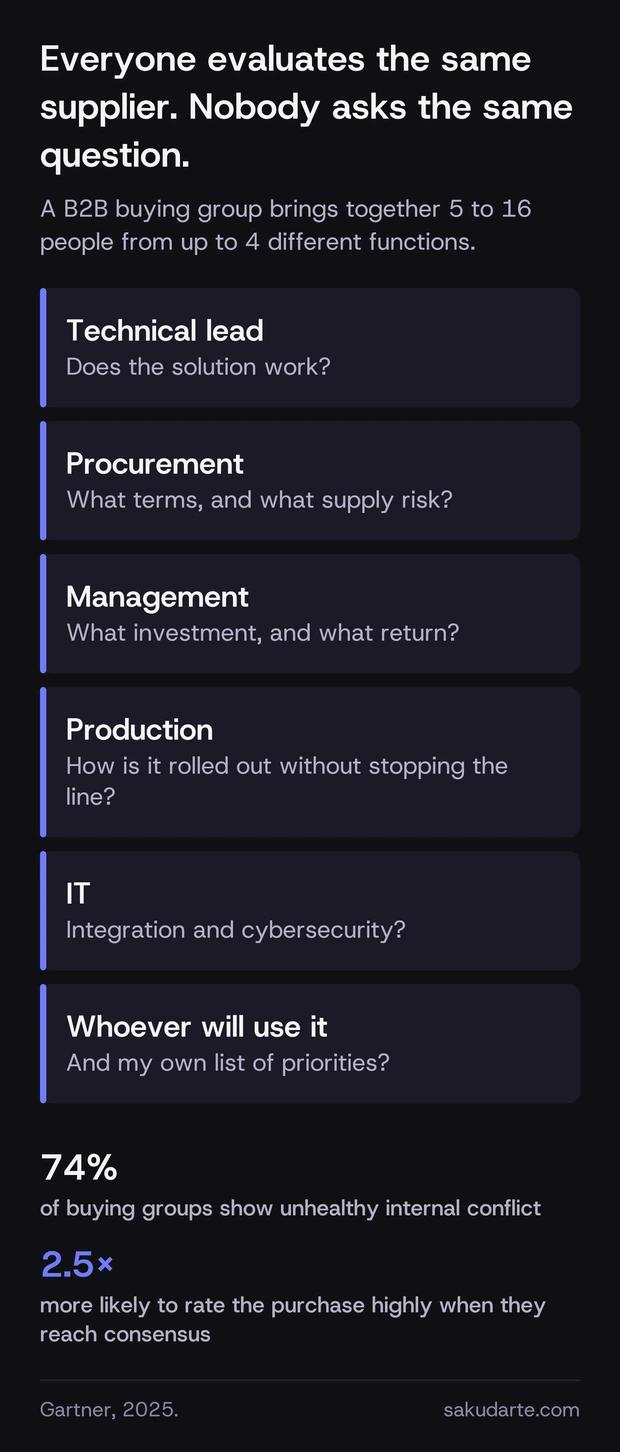
The technical manager wants to make sure the solution works. Purchasing looks at commercial conditions and supply risk. Senior management studies investment and return. Operations thinks about implementation. IT may be concerned about integration and cybersecurity, while the person who will use the solution every day probably has a completely different list of priorities.
They are all evaluating the same supplier, but they are not asking the same question.
This forces us to reconsider a classic idea in segmentation. It is not enough to know "the decision-maker"; we need to understand how consensus is built within the customer organisation and what arguments each profile needs in order to defend the decision to everyone else.
There is another particularly interesting figure in the same study: buying groups that managed to reach consensus were 2.5 times more likely to believe they had made a high-quality purchase.
Perhaps part of industrial marketing is not so much about persuading one person as giving that person the material they need to persuade the other five people in the room when we are no longer there.
3. Marketing and sales can no longer operate as two consecutive processes
For years, we worked with a fairly convenient boundary.
Marketing generated leads and, at some point, handed them over to sales. From there, "the sales process" began.
The problem is that the customer never saw that boundary.
For them, the page they found on Google, the article they read, the presentation they received after a meeting, the salesperson's email and the conversation at a trade fair all belong to the same company. If each one tells a different story, it makes little difference which department produced it.
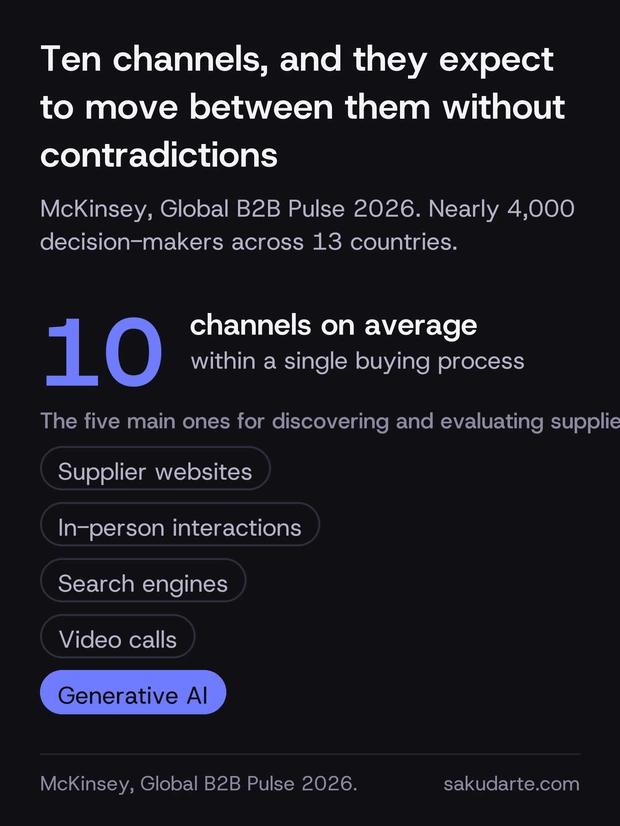
McKinsey has been observing this mix of channels for years, and its Global B2B Pulse 2026, based on nearly 4,000 decision-makers across 13 countries, shows how firmly established it has become: buyers use an average of ten different channels during the buying process and expect to move between them without contradictions or friction.
This makes alignment between marketing and sales something much deeper than a monthly meeting to review leads.
Marketing needs to hear which objections emerge in sales conversations, why deals are lost, which questions keep coming up and which competitors appear most often. Sales, meanwhile, needs to understand what information the market has already consumed, which content is generating interest and how the company is presenting itself before they enter the conversation.
A B2B marketing strategy makes sense when it connects those two worlds and allows learning to travel in both directions.
This is not about turning marketing into sales or sales into a communications department. It is about accepting that both are participating in the same customer decision.
4. Explaining value does not mean hiding the product
Another familiar statement in industrial marketing is: "We need to stop talking about features and start talking about benefits."
The intention is good, but taken too far it can produce industrial websites where it becomes almost impossible to work out what the company actually makes.
A technical buyer needs specifications.
They want to know materials, tolerances, capabilities, performance, compatibility, certifications, speeds, consumption or operating conditions. That information is not a problem we need to hide behind three broad emotional concepts.
What we need is to connect the specification with what it means for the customer.
If a machine reduces a changeover from forty minutes to ten, we do not have to choose between explaining how it does that and explaining what it means for production. We can do both. If a component has a particular level of resistance, it makes sense to explain the technical characteristic and also the applications in which that characteristic creates a real advantage.
The challenge in industrial marketing is not to simplify complex products until they become unrecognisable. It is to establish a hierarchy that allows each person to reach the level of depth they need.
Senior management may begin with the business impact. Engineering will want to understand how it works. Purchasing will need to check other issues. All three may be reading the same page.
That is well-structured technical communication, not a choice between marketing and product.
5. Branding does not remove price from the conversation, but it stops price being the only thing we have
"A strong brand gets you out of the price conversation" is another attractive statement that deserves some qualification.
Price always matters.
Especially when we are talking about major investments, recurring purchases or components that directly affect a customer's margin. Pretending that good branding makes that conversation disappear would be giving it almost supernatural powers.
What a strong brand can do is make sure price is not the only variable available for comparison.
In B2B, a brand can concentrate associations around experience, specialisation, reliability, market knowledge or responsiveness. All of these can help reduce perceived risk, which matters particularly when a bad decision could stop a plant or compromise a project for years.
There is another interesting issue here: companies do not always communicate what their customers consider most important.
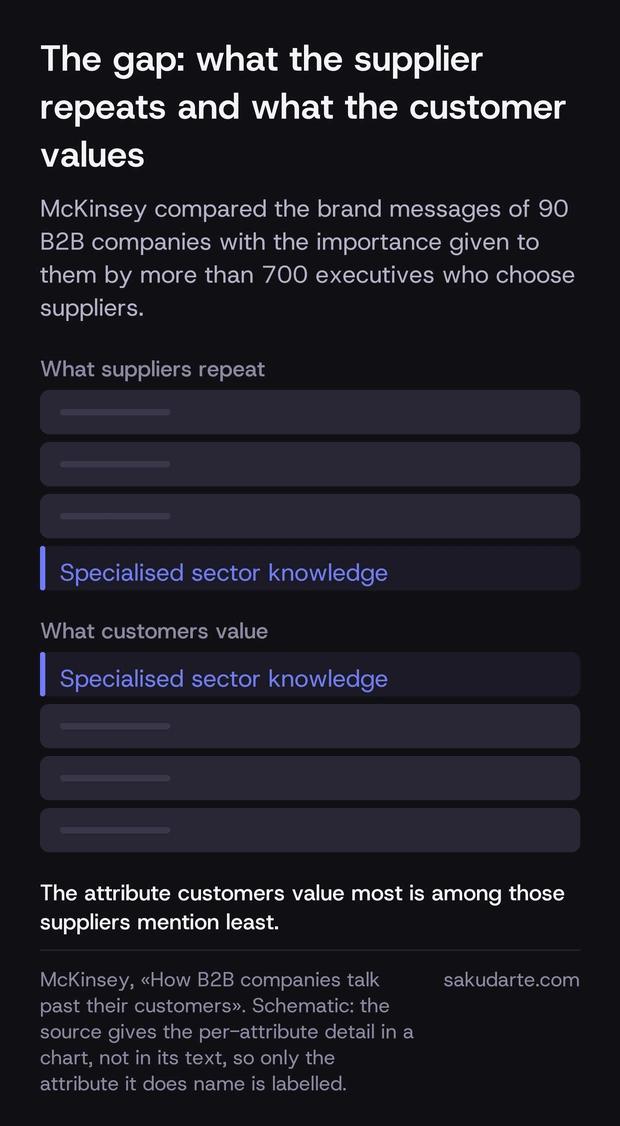
McKinsey research that analysed the messaging of major B2B companies and compared it with how their customers perceived them found a gap between the attributes businesses repeatedly communicated and those buyers associated with strong brands. Specialist market knowledge turned out to be one of the qualities customers valued most and, at the same time, one of the least mentioned by suppliers.
That is why working on B2B branding is not simply about making a company look more attractive.
It is about deciding what we want to be recognised for and proving it consistently.
If our only visible difference is price, that is inevitably where the conversation will end up. But often the problem is not that we have no other differences; it is that we have never managed to explain them properly.
6. An industrial company can have personality without losing credibility
The original article said that an industrial company can, and should, be "sexy".
The word has a certain charm, although today we would probably put it differently.
An industrial brand can have personality.
Being rigorous does not mean always using dark blue, photographs of handshakes and headlines written in exactly the same language as the other twenty suppliers in the category.
B2B communication has spent far too long confusing professionalism with neutrality, as if a company became more trustworthy the less recognisable it was.
But the people receiving that communication are still people. They do not leave their sensitivity, sense of humour or appreciation for good design at the factory reception when they clock in each morning.
Naturally, a company supplying components for a nuclear power plant does not need to communicate like a sneaker brand. Nor should an engineering company turn its website into a creative festival that makes technical documentation impossible to find.
The question is different: can we be recognisable without losing credibility?
Of course we can.
A distinctive photographic direction, a characteristic way of explaining concepts, a coherent visual identity or a less predictable tone of voice can all help build memory. In markets where technical offers tend to look similar from the outside, that personality also becomes part of differentiation.
Serious does not have to mean grey.
7. Doing it well is still essential; proving it is part of the job
There are exceptionally good industrial companies that almost force potential customers to take a leap of faith to discover it.
The website says very little. Projects are never published because "everything is confidential". The people behind the business are invisible. Capabilities are taken for granted and decades of expertise are reduced to a sentence claiming that the company has been a leader since 1987.
Meanwhile, a competitor may have less experience but explain it much better.
We do not believe marketing is about "telling it better" if that means dressing up reality. The point is to make visible what already exists and what can help a customer make a decision.
If we have solved a complex problem, we can build a case study even if the client needs to remain anonymous. If we have a distinctive technology, we can explain how it works. If our technical team is exceptional, perhaps it deserves a voice. If a certification matters, it should be easy to find.
B2B content marketing has a much more useful role here than simply feeding social media. It turns internal expertise into information the market can use during the buying process.
And in 2026 there is another reason to take this seriously.
McKinsey now places generative AI among the five leading channels used by B2B buyers to discover and evaluate suppliers, alongside supplier websites, face-to-face interactions, search engines and video calls.
That does not mean filling a website with copy written "for AI". Quite the opposite: if we want to be found and interpreted correctly, we need original, specific, well-structured and verifiable information.
An AI tool cannot explain what we have never bothered to explain ourselves.
8. In industrial marketing, reaching fewer people can be excellent news
Many marketing metrics were created in markets where growth meant reaching ever larger audiences.
More impressions, more visits, more followers, more contacts.
In industry, the reality may be very different.
Perhaps only 300 companies in Europe are capable of buying our solution. Maybe there are 50 genuinely interesting accounts in Spain and the average deal takes nine months to close. In that scenario, attracting 100,000 visits is not necessarily better than attracting 500.
It depends on who is behind them.
That is why industrial marketing needs a clear idea of priorities: sectors, markets, company types, roles and opportunities worth investing effort in.
B2B advertising can be especially useful when it allows us to reach specific profiles or accounts, but targeting alone does not guarantee results. The message needs to be relevant, the proposition credible and the destination must help the user continue their research.
The same applies to any other activity.
The objective should not be to maximise activity, but to increase the probability of appearing in front of the right companies with enough evidence to be considered.
That also means measuring differently.
A report showing thousands of impressions can be reassuring, but it may be more useful to know which companies are visiting the website, how many enquiries become opportunities, which sectors progress most effectively or which pieces of content help the sales team during a negotiation.
In B2B, one relevant visit can be worth far more than a thousand accidental ones.
So what has really changed in industrial marketing?
Probably fewer things than it seems, and more than we might like to admit.
Trust still matters. Experience still matters. The product still has to work, the salesperson still needs to understand the business and relationships remain fundamental.
What has changed is how the customer reaches those relationships and how much information they have processed before starting them.
Today, buyers research with greater autonomy, use more channels, incorporate AI tools and make decisions within groups where consensus does not always come easily. They expect to be able to verify part of what we say independently and, when they finally speak to sales, they need that conversation to add something beyond the information they could already find for themselves.
This also explains why we are increasingly less interested in thinking about marketing as a collection of separate activities.
Brand influences how we are perceived. The website allows people to research us. Content demonstrates expertise. Campaigns create visibility. Sales interprets, validates and reduces risk. Analytics helps us understand what is working and what is not.
When those pieces work separately, the customer has to do the work of joining them together.
When they work together, the company becomes much easier to understand.
And perhaps that remains one of the most important functions of industrial marketing: making a complex company understandable, relevant and trustworthy to the people who have to decide whether they want to do business with it.
If you are specifically looking for how we work on industrial marketing with manufacturers, engineering firms and technology and agri-food companies, that is the page where we explain our service approach. This article has a different purpose: to provide context for the changes transforming the way industrial companies are found, evaluated and selected as suppliers.
You can also explore our B2B marketing projects to see how strategy, brand, websites, content and commercial activation come together differently depending on each company's market and buying process.
Sources
- Gartner, March 2026: 67% of B2B buyers prefer a rep-free experience
- Gartner, May 2026: 69% turn to sales reps to validate AI-generated insights
- Gartner, May 2025: 74% of B2B buying groups show unhealthy conflict
- McKinsey, Global B2B Pulse 2026: buyers use ten channels on average
- McKinsey: How B2B companies talk past their customers