
B2B conversion funnel: why your customer doesn’t buy in a straight line
No company buys in a straight line. The funnel is still useful for measuring marketing and sales, but it describes the real decision poorly: the non-linear journey, buying committees and how to use the funnel without mistaking it for reality.
For years, we have drawn the buying process as a fairly tidy funnel. At the top, we placed a large number of people discovering a company; then came consideration, decision and, finally, a much smaller group reaching the purchase stage.
As a way of explaining marketing, it works very well.
The problem begins when we start believing customers actually buy like that.
Anyone who has taken part in a reasonably complex B2B sale will have experienced something quite different. A potential customer discovers a solution, visits several websites, speaks to a supplier, puts the project on hold for two months and comes back after an internal meeting. Engineering reviews the requirements, purchasing introduces an alternative nobody had considered, management asks for a business case and someone joining the process late forces the team to revisit decisions that seemed settled.
Gartner uses the term “looping” to describe precisely this behaviour. Its research into the B2B buying journey shows that buyers do not complete a sequence of stages in order. Instead, they repeatedly return to six buying tasks: identifying the problem, exploring solutions, defining requirements, selecting suppliers, validating the choice and building internal consensus.
That does not make the conversion funnel useless. It is still a practical way to organise metrics, understand where opportunities are being created and identify losses between marketing and sales.
What we need to remember is fairly simple: the funnel is our measurement model, not the customer’s mental map.
And in B2B, that difference matters.
What is a conversion funnel and what is it for?
A conversion funnel represents the different moments between a person or company first coming into contact with our brand and completing an action we have previously defined as valuable.
In an ecommerce business, that action may be a purchase. In an industrial company, it might be requesting information, sending project specifications, downloading technical documentation, asking for a sample or booking a meeting with the sales team.
That is why, before building any funnel, we need to define what we mean by conversion and which earlier actions indicate that an opportunity is progressing.
Its main usefulness lies there. If we generate traffic but nobody requests information, we have a different problem from a company that receives plenty of enquiries but converts very few of them into genuine sales opportunities. Likewise, a business may appear to generate a modest number of leads while actually creating several high-value projects.
The funnel helps separate these moments and identify where the bottleneck may be. What it cannot do on its own is explain why that bottleneck exists.
B2B buyers don’t move through stages: they revisit decisions
The traditional version of the funnel assumes a certain sequence: first we become aware of a brand, then we consider it, later we decide and finally we buy.
The real journey tends to be much less convenient for our spreadsheets.
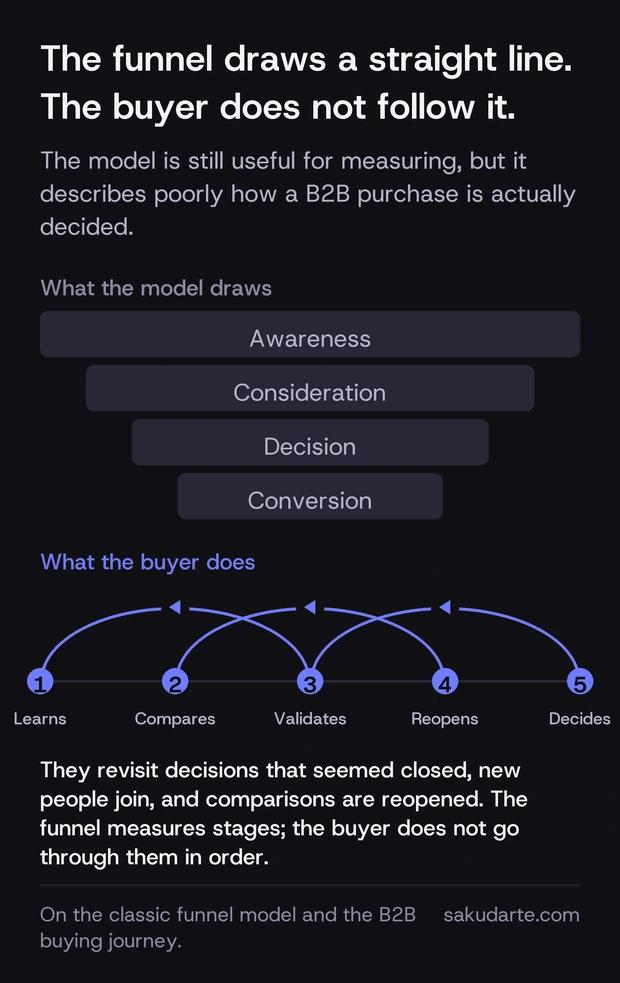
A buying team may shortlist two suppliers and later return to redefine its requirements. It may request a commercial proposal and then discover during the evaluation process that another technology could solve the problem. It may even have more or less chosen a solution and still get stuck because the people involved cannot agree on how much risk they are willing to accept.
Gartner describes this as a process of looping: buying tasks are revisited and can happen simultaneously, without a fixed order. Progress is less about “moving to the next stage” and more about helping the buying group complete those tasks with enough confidence to continue.
This difference is not merely academic. It changes how we interpret data.
A company that returns four times to our technical documentation is not necessarily “further down the funnel” than one that requests a demo on day one. It may simply be trying to build internal consensus. Likewise, an opportunity that returns to questions we thought had already been answered has not necessarily gone backwards; it may simply have brought new decision-makers into the process.
The funnel still helps us organise the journey, but it becomes far more useful once we accept that the buyer does not know our stages and has no obligation to respect them.
In B2B, one person doesn’t buy: a group has to agree
This is one of the major differences between many B2C purchases and a complex business decision.
Although we often talk about a “buyer persona” in the singular, there may be a substantial group of people behind a deal, each with very different priorities.
In May 2025, Gartner reported that B2B buying groups can include between 5 and 16 people across as many as four different functions. In the same study, based on 632 B2B buyers surveyed between August and September 2024, it found that 74% of buying teams showed levels of internal conflict considered unhealthy during the decision process (Gartner, 7 May 2025).
That changes the way we should think about a funnel.
Operations may want to solve an urgent problem as quickly as possible, while purchasing focuses on reducing risk and cost. Engineering will care about technical specifications, IT about integration, finance about return on investment and management about the strategic impact.
And they are all buying the same solution.
This is why one of the most important jobs in B2B marketing is not simply to persuade one person, but to provide arguments that can circulate inside the organisation and help different profiles build a shared view.
In fact, the same Gartner study found that buying groups that reached consensus were 2.5 times more likely to report that their deal had been high-quality.
Perhaps one of the biggest blind spots in the traditional funnel is precisely this: we tend to draw individuals moving down a funnel when, in many deals, what is really trying to move forward is a group.
Five useful moments for understanding the B2B funnel
Even if the journey is not linear, dividing it into broad moments is still useful when deciding what information we can provide and what indicators are worth observing.
The difference is that we should not imagine these moments as rooms with a single entrance and a single exit.
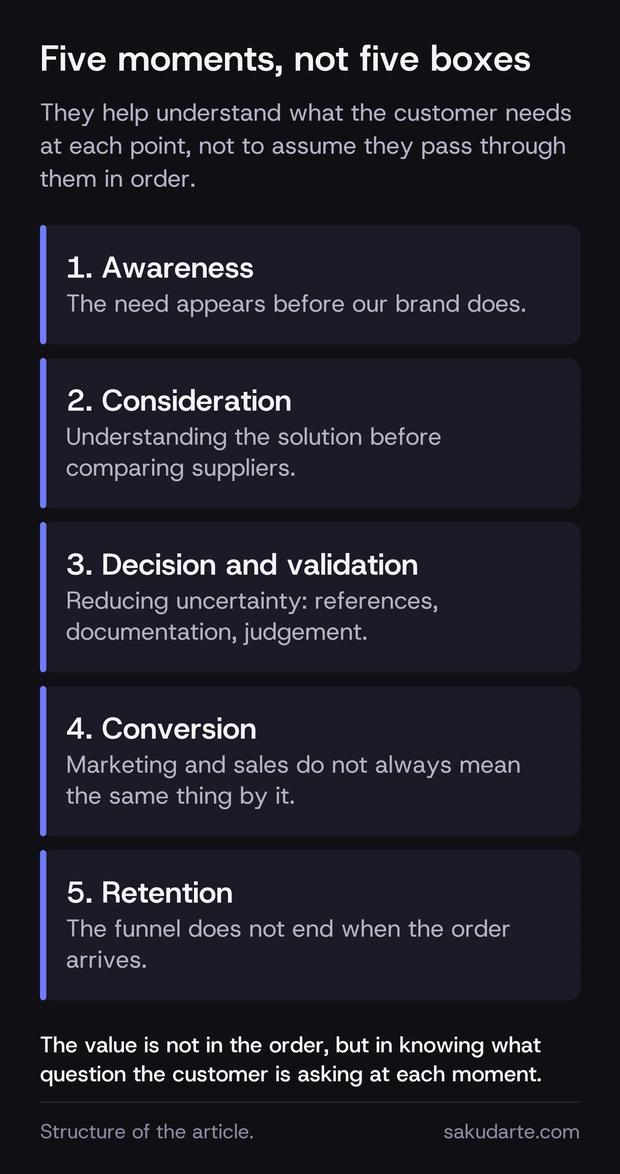
1. Awareness: the need appears before our brand does
At an early stage, a potential customer may recognise a problem without yet knowing what kind of solution they need.
A maintenance manager may search for ways to reduce production downtime before knowing the technical term for the technology that could help. Another professional, with greater market knowledge, may search directly for the solution itself or even begin by comparing suppliers.
Both may end up involved in the same opportunity, but they started from very different places.
That is why the awareness stage should not simply be measured by traffic volume. What matters is whether we are appearing in front of companies and profiles from our priority markets while they are researching problems we know how to solve.
SEO, content, trade media, events, referrals and advertising can all play a role at this stage. The right channel depends on how our market actually researches information.
2. Consideration: understanding the solution before comparing suppliers
The buyer begins to explore alternatives, but that does not necessarily mean they are already comparing our company with three competitors.
They may first be deciding whether to automate a process or keep it manual, make something in-house or outsource it, repair equipment or replace it, adopt one technology or continue with another.
This nuance matters because many companies present their products too early, as if the customer had already accepted every premise leading up to the purchase.
At the consideration stage, content can help people understand the implications of different options before the conversation becomes a commercial negotiation.
Guides, technical articles, comparisons, webinars, demonstrations and real-world cases help buyers go deeper and build decision criteria.
In other words, before convincing the customer that we are the right supplier, we may first need to help them understand what the right decision actually is.
3. Decision and validation: reducing uncertainty
Once the alternatives have narrowed, the questions become more specific.
Production capacity, lead times, references, certifications, implementation, support, warranties, total cost and integration with other systems now become more important.
This is also when the diversity of the buying group becomes particularly visible.
The same proposal needs to be technically sound for engineering, financially defensible for finance and sufficiently low-risk for purchasing. Management may also need to understand what impact the decision will have two years from now.
It is common for an opportunity at this point to return to questions we thought had already been resolved because someone new joins the process and needs to reconstruct part of the decision.
That is not necessarily a funnel failure. It is simply B2B buying happening in real life.
4. Conversion: marketing and sales don’t always mean the same thing
In marketing, we often define conversion as an observable action: a form submission, a request, a download or a meeting booking.
For sales, none of these necessarily constitutes a real opportunity. And for the company, of course, there is still no revenue.
That distinction matters.
A campaign that produces one hundred contacts that the sales team immediately rejects may have an excellent digital conversion rate and contribute very little business. Another activity may generate ten enquiries, three of which become strategically important projects.
That is why marketing and sales need shared criteria: when do we consider a contact qualified, what information do we need, which behaviours indicate intent and when does an opportunity genuinely enter the sales pipeline?
A B2B marketing system makes sense precisely when it connects these pieces and prevents marketing from measuring one reality while sales works with another.
5. Retention: the funnel does not end when the order arrives
In many B2B companies, the first sale is only the beginning of the economic relationship.
A customer may buy again, expand the service, purchase new product families, give us access to other plants or recommend us elsewhere within the group.
That means the post-purchase journey deserves as much attention as acquisition.
Onboarding, documentation, technical support, training, after-sales service and communication can all determine whether the relationship continues to grow or remains a one-off transaction.
Talking about the funnel only until the point of sale feels particularly strange in markets where some customers stay for ten or twenty years.
Ten channels, generative AI and a journey that is getting harder to draw
The idea of a linear funnel also clashes with another reality: buyers constantly move between channels.
McKinsey’s Global B2B Pulse 2026, based on nearly 4,000 decision-makers across 13 countries and multiple industries, reports that buyers use an average of ten channels during the buying process and expect to move between them without friction (McKinsey, 28 May 2026).
One particularly interesting development compared with previous editions is that generative AI is now among the top five channels used to discover and evaluate suppliers, alongside supplier websites, in-person interactions, web search and video calls.
That makes it increasingly unrealistic to attribute a deal to a single journey.
Someone may first ask an AI tool which technologies exist, then discover three suppliers through Google, visit their websites, meet one of them at a trade fair and share a technical page via Teams with four other people in the company.
Our CRM may show only one contact request.
But the decision started much earlier.
This is why an industrial website plays a particular role within the funnel: it often becomes a verification point to which buyers return from different channels to check whether a supplier fits, understand the offer in more depth or find information they need to circulate internally.
What to measure in a B2B funnel
Accepting that the journey is complex does not mean giving up on measurement. It means measuring things that help us understand what is happening.
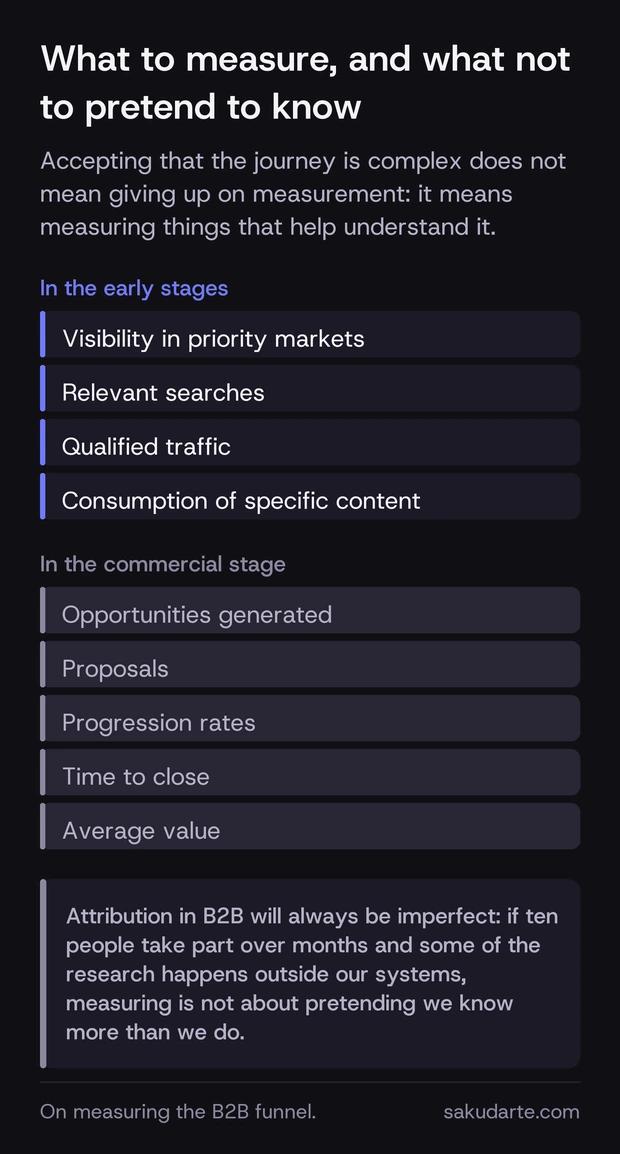
In the early stages, we can analyse visibility in priority markets, relevant searches, qualified traffic and consumption of certain types of content. Later, requests, meetings, document downloads or companies repeatedly returning to key pages may become more important.
Once we enter the commercial stage, it makes more sense to monitor opportunities created, proposals, progression rates, time to close, pipeline value, revenue and repeat business.
We do not need twenty indicators at every stage.
We need to know what question each metric is answering.
Website traffic can tell us something about visibility, but not necessarily commercial quality. Lead volume tells us something about acquisition, but not necessarily about opportunities. And a low cost per lead can turn out to be very expensive if none of those contacts belong to the kind of company we actually want to win.
It is also worth accepting that attribution in B2B will always be imperfect.
If ten people are involved in a purchase, they use several channels over a period of months and part of the research happens outside our systems, pretending we can assign exactly 17.3% of the sale to a LinkedIn post may give us more decimal precision than useful knowledge.
Measurement does not mean pretending we know more than we do.
Where a conversion funnel usually breaks
One of the advantages of the model is that it helps reveal that the problem is not always where the noise is.
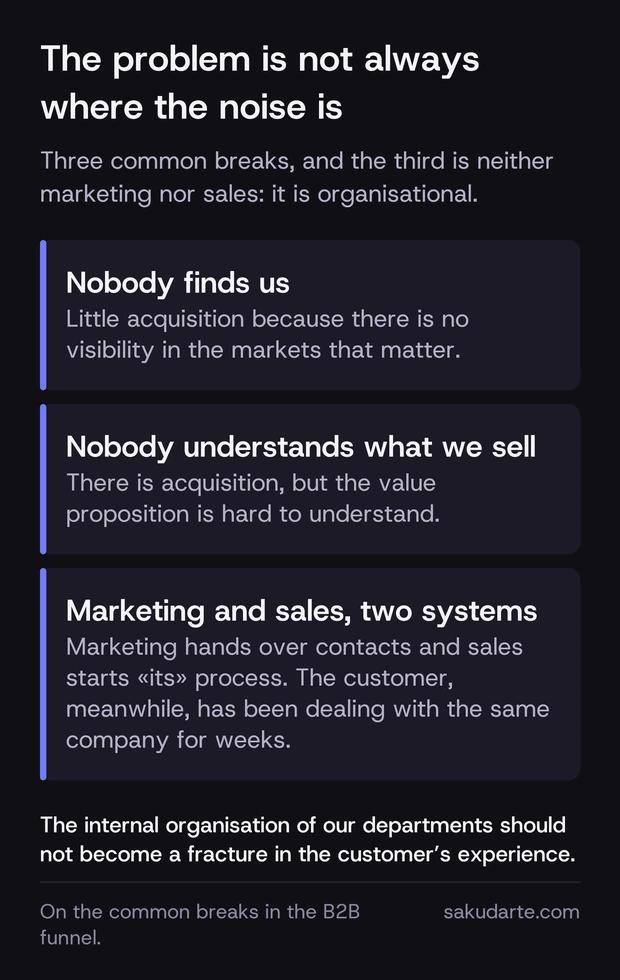
We may have weak acquisition because nobody can find us, but also because our value proposition is difficult to understand. A campaign may attract exactly the right audience and send them to a page that lacks the information they need to progress. The sales team may receive interesting opportunities and lose them because it lacks case studies, technical arguments or materials capable of helping the buying group reach consensus.
There may also be a much simpler problem: marketing and sales operate as two separate systems.
Marketing generates contacts and hands them over. Sales then begins “its” process.
Meanwhile, the customer has probably been interacting with the same company for weeks.
The way we organise our internal departments should not become a break in the customer’s experience.
That is precisely why a B2B marketing strategy should connect visibility, content, digital presence, demand generation, sales tools and opportunity tracking rather than treating them as unrelated projects.
Automation and retargeting: useful, but they do not turn signals into intent
The traditional funnel has encouraged some fairly mechanical interpretations of behaviour.
A user visits three pages, downloads a document and opens two emails. We add points and the system decides we have a “hot lead”.
Maybe we do.
Or maybe it is a student, a competitor, an existing customer or someone carrying out very early-stage research.
Automation, lead scoring and retargeting remain useful tools. They can make follow-up easier, deliver relevant information or keep a solution visible during a long buying process. What they should not do is replace judgement.
In B2B, digital signals need context.
Repeated visits to a pricing page may be highly significant, but the combination of company, role, behaviour, history and sales conversation usually tells us far more than the click on its own.
The funnel works better when we use technology to understand and support the process, rather than turning every behaviour into a prophecy.
So, does it still make sense to talk about a conversion funnel?
Yes.
What we probably need to give up is the comfort of believing the drawing literally represents the buyer.
The funnel remains useful for organising objectives, identifying losses and connecting marketing indicators with commercial outcomes. It helps us see whether we are generating visibility, whether that visibility creates interest, whether that interest turns into opportunities and what happens to those opportunities afterwards.
But B2B buyers behave differently.
Gartner talks about looping because buying teams repeatedly revisit different purchasing tasks. Those teams may include between five and sixteen people, and 74% show internal conflict during the decision process. McKinsey adds another layer: in 2026, buyers use an average of ten channels, and generative AI is already among the top five for discovering and evaluating suppliers.
In that context, perhaps the value of the funnel is not in getting customers to move obediently through our stages, but in helping us ask better questions.
Where do opportunities appear? What information do they need in order to progress? What blocks decisions? Are marketing and sales helping to resolve the same questions? Do we have content that can circulate within a buying committee? Is the experience coherent when the customer moves from Google to our website, from an AI tool to a sales meeting or from a trade fair to technical documentation?
If the funnel helps us understand those questions better, it remains a valuable tool.
We just need to avoid asking it to do something it was never designed to do: draw a straight line through a buying process that stopped being linear a long time ago.
In our projects you can see different examples where strategy, content, digital presence and commercial activation are treated as parts of the same system, precisely because customers do not experience them separately.
This article is part of our B2B marketing strategy.