
Industrial website: what it is and how it should work in B2B
What makes an industrial website different from a conventional corporate website? We look at how a B2B website should be structured to explain technical products and services, build trust and support customers throughout the buying process.
A few years ago, it was quite common to say that a website was an industrial company’s best salesperson. We used that expression ourselves more than once and, although the idea behind it still makes sense, today we would add a few nuances.
A good salesperson listens, interprets what is happening in front of them, asks questions, identifies objections and adapts their message to the conversation. A website does not do exactly that, but it does have one characteristic that makes it a fundamental part of the B2B sales process: very often, a potential customer reaches it before speaking to anyone from our company.
When a purchasing manager looks for new suppliers, an engineer compares technologies, someone in production needs to solve a problem or senior management wants to know whether a particular company has the capacity to handle a project, the website is already influencing the decision. There may not yet be an opportunity registered in the CRM and nobody may have requested a quote, but the company is already being assessed.
That is why we think it makes sense to view an industrial website not as a digital shop window, but as a tool that should help customers understand a business that is usually anything but simple.
What is an industrial website?
An industrial website is a website designed to meet the communication and business needs of a company that sells products, services, technology or technical expertise to other organisations.
The definition may seem fairly obvious, but it has important implications. It is not enough to take a conventional corporate website, add a few photographs of machinery and create a products section. A company that manufactures components for different industries, an engineering firm that develops bespoke projects or a business that sells technical equipment needs to explain far more than a company with a simple offer and an immediate buying process.
A good industrial website should make it possible to understand what the company does, what problems it can solve, which sectors it works with, what its capabilities are, which products or technologies it offers and why someone should trust it. It also has to organise what can be a very large amount of technical information without turning navigation into an endurance test.
That balance between technical depth and commercial clarity is probably one of its defining characteristics.
It is also worth separating two different intentions here. This article is intended to explain how this kind of website works and which aspects are worth considering. If what you are looking for is specifically our industrial web design service for B2B companies, that is where we explain how we approach these projects at Sakudarte.
How industrial customers buy today
B2B buyers have been gaining greater autonomy in the early stages of the buying process for years. What has changed more recently is the number of tools available to them to research suppliers, understand technologies and compare alternatives before starting a sales conversation.
In March 2026, Gartner published the results of a survey of 646 B2B buyers carried out between August and September 2025. 67% said they preferred a sales-rep-free experience, while 45% said they had used artificial intelligence during a recent purchase. It offers a fairly clear picture of how much early-stage research is moving towards digital self-service channels.
However, interpreting these figures as the beginning of the end for sales teams would be a mistake. In May 2026, another Gartner study involving 645 B2B buyers found that 69% prefer to validate AI-generated information with sales professionals. The same study also found that buyers had used an average of seven sources of information during a recent purchase.
What we are seeing, then, is not people being replaced by digital channels, but a reorganisation of the process. Customers want to move forward independently while they can, and turn to a person when they need context, reassurance, interpretation or help making a decision.
McKinsey’s 2024 B2B Pulse research offers another interesting perspective. B2B buyers use an average of ten interaction channels throughout their journey, and the three most frequently used touchpoints are the supplier’s website, in-person sales and video calls. Preferences for in-person, remote and digital self-service interactions are also divided roughly into thirds.
All of this changes the question we should ask when planning an industrial website. It is no longer just about deciding what we want to say, but about understanding what a potential customer needs to know in order to decide whether we are worth investigating further.
What information does a B2B buyer need to find?
Many industrial companies work with products or services that require explanation. A machine may have dozens of configurations, a component may vary depending on materials, tolerances or application, and an engineering company may develop completely different solutions depending on the sector.
The problem is not that the offer is complex. In many cases, that complexity is precisely part of the company’s value. The problem arises when we transfer our entire internal structure, catalogue and technical knowledge onto the website without filtering or organising it, and then expect visitors to find their own way around.
Someone arriving for the first time should be able to form a reasonably clear idea of what the company does, who it works for and what problems it solves before diving into detailed specifications. There will be time afterwards to explore materials, tolerances, flow rates, power ratings, regulations, speeds, production capabilities or any other relevant variable.
The architecture should reflect the customer more than the organisation chart
One of the most common mistakes is to structure a website according to the way the company is organised internally. From the inside, it feels natural because we know the divisions, departments, product families and business units, but the customer does not necessarily share that logic.
Some buyers begin with a specific product, while others arrive looking for an application, a technology or a solution to a problem. Even within the same company, several different navigation paths may need to coexist.
An industrial automation company may need to combine solutions and sectors. A manufacturer with thousands of references will probably need a deeper product architecture, with filters or search tools. An engineering company based on bespoke projects may need to rely much more heavily on capabilities, applications and real cases.
There is no universal website architecture because there is no single way to buy industrial technology.
Technical content needs hierarchy, not scissors
When we talk about digital communication, the idea that everything has to be very short comes up frequently. In industry, that is not always possible and we do not think it is particularly useful either.
A buyer seriously evaluating a solution may need to know materials, dimensions, certifications, compatibility, performance, regulatory requirements, environmental conditions or available configurations. That information is not unnecessary, but it does need hierarchy.
We can begin by explaining what a product solves and in which situations it makes sense to use it, then develop its benefits, features and applications, and finally allow those who need greater depth to consult datasheets, drawings, certificates or technical documentation.
This allows senior managers, sales professionals, technical teams and purchasing departments to access different levels of detail without forcing everyone down exactly the same path.
Saying we are good is not enough
Quality, innovation, experience, commitment, technology and proximity are words that appear on so many corporate websites that they have lost some of their power to differentiate.
The problem is not that they are false. Many companies can probably support them with good arguments. The problem is that when the whole market uses exactly the same words, they stop helping customers choose.
That is why evidence matters so much. Facilities, production capabilities, certifications, markets served, people, technical information and, above all, completed projects allow generic claims to become something visitors can actually verify.
Case studies and B2B projects are particularly useful because they answer one of the questions that almost inevitably arises when a supplier is being assessed: “Have they solved something similar to what we need before?”
How a good industrial website is built
Once content and architecture have been organised, it is time to give them form. Design, user experience, photography, development and technical performance should not work as separate compartments, because all of them influence the way someone understands the company.
Design has to help people understand
Design matters a great deal on an industrial website, although not necessarily because of its ability to impress.
Good visual hierarchy helps distinguish primary from secondary information. Composition can make features easier to compare, an illustration can explain a process that would be difficult to describe in words alone, and a well-designed navigation system can help someone find a specific reference within a huge catalogue.
Naturally, aesthetics also shape perception. A company that presents itself in a polished, coherent and contemporary way sends certain signals about how it understands its own business. However, if a visually spectacular website makes it difficult to find a product, download a datasheet or understand what the company actually sells, design has become part of the problem.
Good design often means making the experience clear enough that visitors do not have to think too much about the design itself.
Industrial photography also provides information
Many industrial companies still use stock photography to represent concepts such as innovation, technology or Industry 4.0. These images are often flawless, but they have an obvious drawback: they could belong to almost any company.
Real photography makes it possible to show facilities, processes, machinery, people, materials, products and scale. For someone who works in a factory every day, certain spaces may seem completely ordinary, but a buyer two thousand kilometres away may gain valuable information from a good image about size, technology, production capacity or ways of working.
Not every photography session needs to become a major production. But it is worth deciding what we want to show and why, because a well-chosen industrial image can convey as much information as several paragraphs of text.
How people find an industrial website: SEO and artificial intelligence
A website becomes particularly interesting as a business asset when it manages to appear in front of people who do not yet know the company.
Someone who already knows our name will probably find us easily. The more valuable work is becoming visible when someone searches for a technology, machine, component, application or solution to a particular problem and does not yet know which suppliers can provide it.
Industrial SEO: understanding how the market speaks
Working on organic search visibility in industry is not about repeating a keyword several times on a page. It starts much earlier, by trying to understand how the market searches.
In some companies, we discover that internal terminology does not exactly match the language used by customers. The same solution may have different names depending on the country, and some products are searched for not only by their technical name but also by the application in which they are used or the problem they help solve.
Analysing those searches makes it possible to take better decisions about architecture, categories, product pages and content. It also provides information that can be useful beyond SEO because it forces the company to compare its own language with the language the market actually uses.
This is where B2B content marketing becomes particularly important. Guides, technical articles, case studies, application pages or answers to specific questions expand the information available and capture searches that would be difficult to address on a purely commercial page.
What changes with AI-assisted search?
The incorporation of artificial intelligence into the B2B research process adds a new channel, but we do not believe it justifies abandoning everything we have learned so far and starting again with a new collection of acronyms.
The 2026 Gartner data mentioned earlier indicates that 45% of the buyers surveyed had used AI during a recent purchase, particularly to gather information about suppliers and products.
If we want a company to be interpreted correctly by people, search engines and generative systems alike, we still need to explain precisely what it does, structure information properly, answer specific questions and demonstrate expertise through original, verifiable content.
A page claiming that we are “leaders in innovative, cutting-edge solutions” provides very little information to anyone trying to understand the business. Explaining what we manufacture, for which applications, with what capabilities and for which industries is far more useful, regardless of whether the information is being processed by a person, Google or an AI tool.
The interfaces through which we search will change. Clarity will remain useful.
Building the website ready for it is the starting point. What comes next —choosing terms, publishing and earning authority— is separate work, and we explain it under B2B SEO.
Industrial websites and internationalisation
For many Spanish industrial companies, the website has an international dimension from the outset. In those cases, adding a language selector is necessary, but it is a long way from solving the entire strategy.
Adapting a website to new markets means asking which products should be prioritised, which terminology the sector uses in each country, which arguments matter most to those buyers and which evidence of experience is likely to be most convincing.
There may be markets where a particular certification is essential, sectors where we have especially valuable references or countries where a local distributor should have greater prominence. Even the way people search for the same technology may change between languages.
That is why we prefer to talk about adapting a website to international markets rather than simply translating it. Not every company needs dozens of language versions; it is far more important to work properly on the markets it genuinely wants to develop.
Conversion: not everyone is ready to request a quote
When a website is designed around business objectives, the word “conversion” inevitably appears, usually followed almost immediately by a request-a-quote form.
Of course we want to make that action easy, but not every visitor to an industrial website is at that stage of the buying process.
One person may be carrying out an initial supplier search, while another needs to download technical documentation to include a solution in a project. A maintenance manager may have a specific query, while an international buyer may want to locate the right distributor before continuing.
Each needs a different next step.
A website can make it easy to download documentation, view a project, contact a specialist, locate a distributor or access additional information. Requesting a quote will be one of the possibilities, but not necessarily the only one or the right one for every visitor.
Conversion makes more sense when it supports the decision-making process rather than trying to force it.
The website as part of marketing and sales
An industrial website does not exist in isolation. It receives traffic from search engines, LinkedIn, email marketing, trade fairs, advertising campaigns, technical publications and links shared directly by salespeople.
In turn, the sales team itself can use the website to show a project, send a product page, share documentation or reinforce certain arguments after a meeting.
That is why a website becomes much more valuable when it is planned in connection with the company’s other assets.
Renold is an interesting example among our B2B marketing projects: a very broad industrial offering needed to be transformed into a more commercial and global digital architecture. The challenge was not simply to refresh an interface, but to organise a large amount of information so that the market could understand it and navigate it more easily.

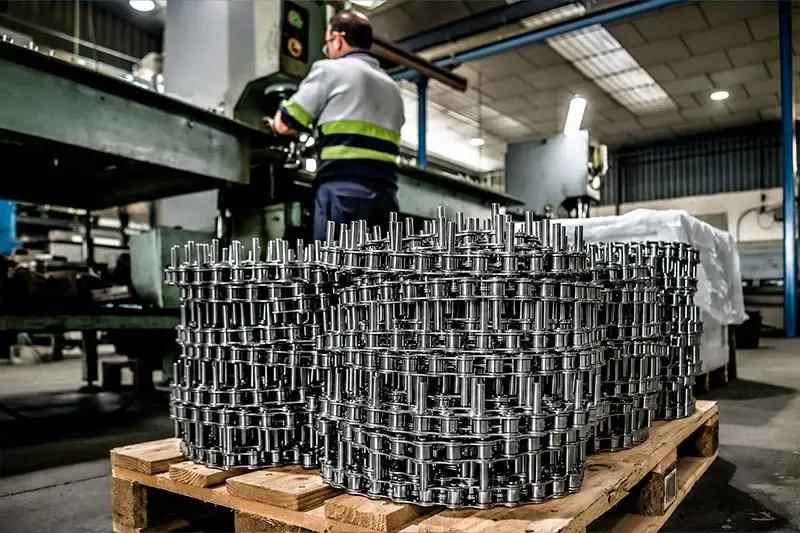
The website can also become the destination for B2B advertising and social selling. A campaign that sends traffic to a page unable to explain the solution properly will not solve that problem simply by increasing media spend. In the same way, a good page without mechanisms to generate visibility will depend too heavily on customers arriving by chance.
Consistency between strategy, content, website and activation is more useful than optimising each element as if it existed independently.
How to measure an industrial website
Publishing a new website should not be the end of the project, because from that point onwards we can begin observing how people actually use it.
Analytics can show which products attract the most attention, which searches generate visits, which countries users come from, which pages lead to commercial enquiries and where people leave. Search Console provides information about organic visibility and, if the company properly connects its website and CRM, it becomes possible to approximate the relationship between certain content and later sales opportunities.
In B2B, that attribution will never be perfect. A sale may take six, nine or twelve months and, during that period, the customer may have visited the website, received emails, spoken to salespeople, attended a trade fair and consulted technical documentation.
That is precisely why it is worth avoiding overly superficial metrics.
An industrial website with twenty thousand monthly visits may contribute very little business if most of that traffic comes from irrelevant markets or profiles. Another may receive far less traffic and still attract visits regularly from exactly the companies that matter.
Volume explains part of the story, but traffic quality and its relationship with business objectives usually explain far more.
How can we tell whether an industrial website is doing its job?
We do not believe there is a single template capable of evaluating every industrial website in the same way. The needs of a company with 5,000 product references are not the same as those of an engineering firm that delivers ten major projects a year.
What we can do is look at the website from the buyer’s perspective and ask a few questions.
Can someone who does not know the company understand what it does and who it works for? Can they find the technical information they need without getting lost? Is experience demonstrated through evidence, or does it depend mainly on commercial claims? Does the structure follow the customer’s logic or simply reproduce our organisation chart? Does the website communicate the true scale of the company and can it be found by people who do not yet know the brand? When someone decides to move forward, is there a logical way for them to do so?
That is where the difference begins to emerge between simply having a corporate website and having a digital presence that genuinely participates in the sales process.
An industrial website is unlikely to close the sale of a multimillion-euro production line on its own, nor should it try to replace the technical conversations required by a complex project. Its role is to help the company be found, understood and considered before, during and after those conversations.
It can help a potential customer discover a solution they did not know existed, understand a supplier’s true capabilities, find answers before making contact or share information with other people involved in the decision. And precisely because the B2B buying process now takes place across different channels and moments, the website occupies a particular position: it is one of the places where brand, product, technical expertise, content and commercial arguments all have to coexist in an organised way.
Perhaps that is why we are no longer entirely convinced by the idea of defining it simply as “the best salesperson”.
It seems more accurate to see it as the place where an industrial company has to make sure that someone who does not yet know it understands why it is worth getting to know better.
Frequently asked questions about a manufacturer’s website
What should a manufacturer’s website include?
Four things an ordinary corporate website usually lacks: a navigable technical catalogue, product pages with specifications, a downloads area and the languages of the markets it sells to. The rest —who we are, what we do, contact— is on every website. Those four are what a technical buyer checks before deciding whether it is worth getting in touch.
How should a technical catalogue be organised on a website?
Around the problem each product family solves, not around the org chart or the internal reference. People arrive through an application —measuring the viscosity of a paint, moving loads in a warehouse— and hardly ever know the article code.
The PDF catalogue is still needed: it is what gets downloaded by someone comparing suppliers, or passed on to a third party. But it cannot be the only way to see the product, because a PDF does not rank, cannot be linked product by product and cannot be measured. At NEURTEK that was precisely the work: ordering families, catalogues and product pages so the same information worked on paper and on screen.
What should an industrial product page contain?
Whatever lets someone rule it in or out without calling anyone: specifications, the standards and certifications it meets, typical applications, variants and the documentation available to download.
And a way to get in touch from the product page itself. If someone has got that far and has a specific question, sending them back to the generic form loses the most qualified enquiry of the day.
Is a downloads area necessary?
If the product is specified before it is bought, yes: drawings, CAD files, certificates, safety data sheets, manuals. That is what turns the website into a working tool for the customer, and what brings them back without a campaign in between.
The real question is what you ask in return. Our rule: open up whatever helps evaluation —data sheets, certificates, installation drawings— and keep the form for what genuinely justifies it, such as a bespoke configuration. A gate in front of a two-page PDF does not generate leads, it generates fake email addresses.
Which languages should an exporting company’s website be in?
Those of the markets where someone can actually answer the enquiry that comes in, whether in-house or through a distributor. One language more than you can answer does not open a market: it leaves enquiries unanswered.
And translating is not positioning. Each language needs its own keyword research, because markets do not name the same product in the same way: at Textil Olius the study covered five languages and markets before a single page was written.
This article is part of our B2B web design.