
Industrial SEO: the guide B2B manufacturers do not have
B2B SEO guides are written for marketing managers in general. In industry four things change: the long cycle, the buying committee, the distributor and the distance between technical and commercial vocabulary.
A manufacturer may produce an exceptionally specific component, supply customers in several countries and have years of engineering knowledge behind its product. Yet the people searching for that knowledge may never find its website.
The issue is not always technical SEO. Often, the manufacturer describes what it makes while its potential customers search in a completely different way. An engineer searches for a standard or material. A maintenance team describes a failure. A buyer wants to know whether a part can be supplied, documented and supported in a particular market.
Those searches may relate to the same commercial opportunity, but they do not ask the same question. A single product page cannot be expected to answer them all.
That is the real challenge of industrial SEO: matching useful information to different stages of a long buying process, navigating the relationship between manufacturers and distributors, and connecting the language of specifications with the language of operational problems. It is not simply conventional B2B search optimisation with more technical nouns.
The objective is not to bring everybody to your site. It is to be found by the people who can specify, evaluate or buy your products, and to help them take a sensible next step.
Why a well-built industrial website can still be hard to find
Many industrial websites are organised in a way that makes perfect sense inside the business. Products sit in categories that mirror the catalogue. Names follow the ERP. Downloads are filed beneath part numbers. Sectors reflect the company's reporting structure.
That organisation is useful for a customer who knows precisely which component they need. It is far less useful for someone still trying to describe a problem.
Consider a supplier of components for equipment operating in challenging environments. One visitor may search for the cause of premature corrosion. Another wants a particular material grade. A third has a drawing and needs to check dimensions. Someone else wants a local source of supply.
All four may be relevant. None is necessarily searching for the company's product name.
The opposite mistake is common, too. A website offers generous commentary on innovation, efficiency or sustainability, yet makes it surprisingly difficult to find a performance curve, a certificate or an up-to-date technical data sheet.
The search query is only part of the story
One technical term can serve several purposes. A search for “IP67” might come from a design engineer, a maintenance technician or someone checking a procurement specification. The term does not tell you the person's job title, buying authority or precise requirement.
Sales teams, technical support and distributors can often answer questions that keyword tools cannot. What do customers routinely misunderstand? Which details are missing from enquiries? Which drawings or certificates cause delays? What does a prospect ask after the first conversation?
This is where search research becomes genuinely relevant to the business. The vocabulary used by customers is evidence, not an invitation to stuff every conceivable variation into a page.
The buying cycle is long, and the search intent changes
Industrial purchases often move through investigation, specification, evaluation and supply. The same project can produce very different searches at each stage. The involvement of several people in a purchasing decision is explored separately in our article on changes in industrial buying; here, the issue is how their changing questions affect search.
Early on, a team may be looking for possible causes of a failure or ways to improve performance. Later, it needs to establish technical requirements. Eventually, the questions become more practical: is the product compliant, can it be supplied, who supports it, and what information is needed for a quotation?
An effective content structure recognises those changes. It does not assume that a visitor who has only identified a problem wants to complete a “request a quote” form immediately.
Before the buyer knows the right product name
Imagine a machine repeatedly experiencing sealing failures. The initial research may focus on operating conditions, failure mechanisms or selection criteria rather than a manufacturer's part number.
A useful page explains the factors that could be involved, which questions need investigation and what kinds of approaches might be appropriate. It should also be clear about limitations. Not every failure has a simple cause and not every product is a solution.
This matters commercially. Pages that attract irrelevant enquiries can increase traffic while consuming the time of the very engineers and salespeople the business needs to protect.
A good early-stage technical article helps the reader define the problem more accurately. It can lead naturally to a product family once the relevant criteria have been established.
It should not disguise an advertisement as a troubleshooting guide.
When the requirement becomes a specification
Further into the process, searches become narrower: material grades, protection ratings, dimensions, operating ranges, standards, connection types, drawings and reference numbers.
At this point, beautiful storytelling will not compensate for missing specifications. A visitor needs to assess suitability and verify the information against the project requirement.
Product and category pages should make essential details easy to locate. Relevant certificates, data sheets, manuals and drawings should be accessible and clearly identified. If a specification depends on a variant or operating condition, that distinction should not be buried.
PDFs remain essential in many industrial workflows. The problem is relying on them to do all the explanatory work. A page that identifies the product, summarises its verified characteristics and points to the correct version of a document is much more helpful than an unlabelled collection of downloads.
When the question is about supply
Near a purchasing decision, the visitor may care most about distribution, lead times, available configurations, documentation or the right contact for an application.
Manufacturers cannot always publish fixed lead times or prices; these may depend on the market, product and project. They can still explain the enquiry process and what information the sales team needs to respond.
A generic contact form can push all the clarification into a subsequent email exchange. A more relevant enquiry path, designed around the product and the commercial model, may make life easier for both sides.
The search changes because the decision changes. A website that ignores this forces visitors to make the connections between problem, specification and purchase themselves.
Technical language and commercial language are not interchangeable
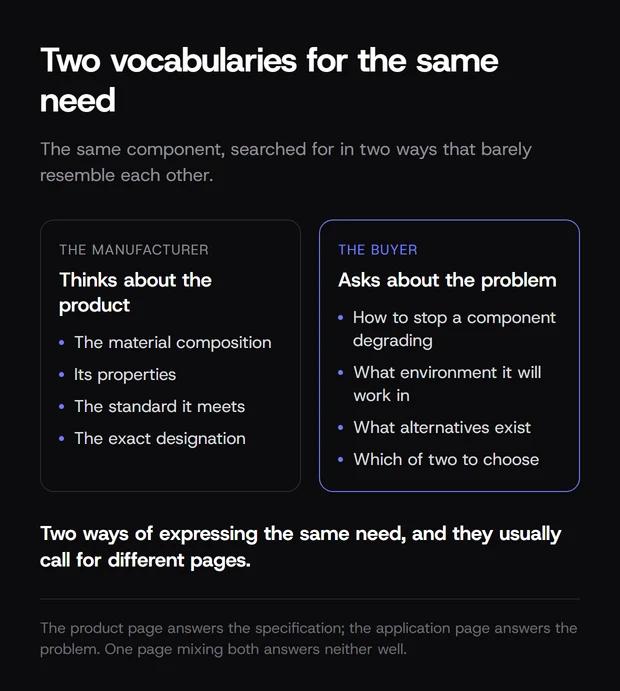
Manufacturers know their products through materials, processes, standards and internal references. Buyers and users may know them through symptoms, applications and operational constraints.
Both languages are legitimate. The mistake is to treat one as the universal language of the market.
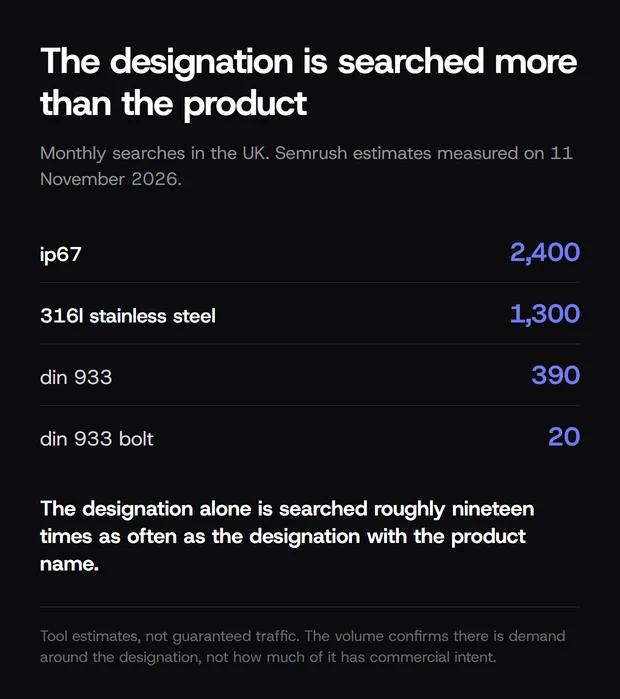
Terms such as “DIN 933”, “316L stainless steel” and “IP67” illustrate specification-led searching. Questions such as “how to prevent corrosion in...” or “alternative to...” illustrate problem-led searching. These are examples of different forms of intent, not interchangeable technical requirements.
The difference is visible in UK search data. According to Semrush estimates for the UK database, measured on 11 November 2026, `ip67` receives around 2,400 searches a month, `316l stainless steel` around 1,300 and `din 933` around 390. The more explicit query `din 933 bolt` receives an estimated 20. The designation alone is searched roughly nineteen times as often as the designation accompanied by the product name. A keyword list built only from catalogue-style product names could overlook that demand.
These figures describe estimated searches, not website visits or guaranteed sales enquiries. A search for a standard or protection rating may be technical research, education or general reference rather than a purchase. The figures demonstrate how people use specification-led terms; they do not tell us how many searchers are buyers.
An engineer looking for a standard may need a precise explanation of what a designation identifies. A maintenance team trying to prevent corrosion needs to consider conditions, material interactions, design and other relevant factors. The answer to one question does not automatically answer the other.
Start with the difference between an application and a specification
An application article can examine failure modes, selection criteria and the circumstances in which alternative approaches may be appropriate. It should explain the reasoning rather than pretend that every problem has one universal solution.
A specification page should support verification. It needs terminology that is correct, variants that are distinguishable and technical evidence that the manufacturer can stand behind.
Where a designation or standard has changed, the engineering team should check the correct current reference before publication. Search popularity is not a reason to imply that different standards, grades or certifications mean the same thing.
Technical precision is not an optional finishing touch. It is what makes the content useful.
The connection matters as much as the individual page
Someone who arrives at an article about a recurring failure should be able to explore relevant selection criteria and, where appropriate, reach suitable product families. Someone arriving directly at a component page may need to read about the operating conditions for which it was designed.
These paths should be visible and logical. The visitor should not need to search the website again every time their question becomes more specific.
This also improves internal conversations. Marketing learns how customers describe problems. Engineering clarifies the technical boundaries. Sales identifies the distinctions that matter in real enquiries.
If those teams cannot agree on the language, publishing more content will not solve the underlying problem.
Why one page cannot serve every intent
A tempting approach is to create one enormous page for a topic, insert every related keyword and hope it becomes the definitive answer.
For industrial products, that often brings several different tasks into conflict.
A visitor investigating a failure wants explanation. A visitor comparing product families wants selection criteria. A visitor searching an exact reference wants the relevant dimensions or documents. Someone adding “supplier UK” to a query may be looking for a purchasing route.
They might ultimately be part of the same buying process. They should not have to dig through the same undifferentiated page.
Give pages a clear purpose
Technical guides can address problems and applications. Category pages help visitors compare relevant product types. Product pages verify specific characteristics. Market or distributor pages explain how supply and support work.

This is not a rigid rule that every website must have four layers. It is a way of checking whether the site is answering distinct questions or making several URLs compete for the same one.
A clear structure lets readers move from problem to criteria, from criteria to a product family, and from that family to verified documentation and the appropriate commercial contact. The wider requirements of an industrial website deserve their own treatment; the point here is to give each search intent a useful destination.
That is more valuable than forcing all search traffic onto the homepage.
Small search volumes do not mean small commercial value
Specialised industrial searches can be narrow. Some are highly relevant despite low volumes; others are broad, popular and not commercially useful to the manufacturer.
Search volume should therefore be weighed against product fit, intent, geography, competitiveness and the company's ability to serve the demand. It cannot make the decision alone.
The specification-led searches above also show why search volume cannot be read as buying intent. A bare designation may attract substantial interest without telling you whether the searcher needs an explanation, a data sheet or a supplier. The results shown for that query, and the products you can actually supply, matter as much as the number.
The same caution applies to catalogue scale. A business with thousands of references does not automatically need thousands of near-identical pages. The key question is whether each page contains information that helps somebody make a distinct decision.
An index full of thin, repetitive URLs can make a website look comprehensive internally while offering very little externally.
The distributor problem: who should rank and who should receive the enquiry?
Much general B2B SEO advice assumes that the company publishing the page also sells the product. In industrial markets, that assumption frequently breaks down.
A manufacturer may sell directly in one territory and through distributors or other partners in another. There may be exclusive agreements, product-specific channels, local service requirements and long-established commercial relationships.
In that environment, ranking first is not automatically the same as winning the right opportunity. The business has to decide who is best placed to answer the particular request.
Manufacturer and distributor may rank for the same search
Suppose a manufacturer publishes authoritative technical information about a component range. Its distributor publishes details about local stock, ordering and service. Both could be relevant to a product search.
The manufacturer's page may be the better destination for drawings, test conditions, material specifications or application limits. The distributor may be the better destination for local availability and procurement.
Neither conclusion should be automatic. It depends on the query and on what the distributor actually provides.
The point is to distinguish authority over product information from responsibility for commercial fulfilment. Those roles overlap, but they are not always identical.
What if the distributor outranks the manufacturer?
It may be entirely appropriate. A customer looking to buy locally might be better served by a distributor who knows the market and can handle the order.
It becomes a problem when the page contains obsolete specifications, gives the wrong impression about availability, uses the brand inaccurately or collects technical enquiries it cannot resolve.
The answer is not necessarily to compete more aggressively for the keyword. First, examine the search intent, the commercial agreement and the experience after the click.
Sometimes the manufacturer should improve its own technical page. Sometimes the distributor needs better shared content and clearer documentation. Sometimes both websites should explain the appropriate route for technical support and purchasing.
A search strategy cannot repair a channel disagreement that the business has not addressed.
Different countries, different routes to market
International manufacturers face a further decision. The same product may be sold directly in one country, through a sole distributor in another and via several partners elsewhere.
Identical calls to action across every country page can therefore send enquiries to the wrong destination.
Before localising content, establish which products are offered, who handles enquiries, whether technical support is available locally and which claims about supply can actually be made.
The implementation of language and regional targeting matters, but it comes after the commercial logic. Correct technical tags cannot make an incorrect sales route useful.
International search is not a translation exercise
The UK is not a single homogeneous industrial audience. The UK government’s Longitudinal Small Business Survey 2025 reports 83,100 SME employers in manufacturing in 2025. It also describes manufacturing as the most finely classified sector, with 95 three-digit SIC codes. Those figures describe the breadth and diversity of the sector, not search demand. They help explain why one generic vocabulary is unlikely to fit every buyer.
A British buyer's search terminology may differ from the terms used by the manufacturer's head office. Even when the product itself is unchanged, the market may describe applications, components and standards differently.
That is one reason to research search behaviour in each target market rather than simply translating a keyword list.
A technically accurate translation may be uncommon in genuine enquiries. A familiar commercial term may be too broad to identify the required product. Local sales teams and distributors can help reveal those differences, but their input should be tested against the questions people actually ask.
Localise the promise, not the specification
The content may need to explain the same product in a different way for a new market. It must not quietly change what the product is capable of doing.
A protection rating, certification, material designation or performance limit should remain subject to technical validation. Standards are not automatically equivalent because they seem to serve a similar purpose.
Likewise, there is little value in attracting a searcher with an offer of local supply or support that the business cannot provide.
International SEO is successful when search visibility reflects a real, serviceable route to market, rather than simply generating visits from more countries.
Give every market version a maintenance owner
Industrial content has a habit of ageing quietly. A reference is discontinued. A document is revised. An option becomes unavailable. The main website changes, but an older local version stays online.
The risk increases with each language and distribution arrangement.
A sensible operating model identifies who owns technical truth, who approves regional commercial information and how changes reach each website. Without that, a perfectly optimised page can become an efficient way to distribute obsolete information.
Technical documents are part of the search experience
Engineers do not stop needing information when they reach a product page. They may need a dimensional drawing, operating instructions, certification, a test report or details of a particular variant.
Those materials are not secondary to marketing content. In some searches, they are the main reason for the visit.
The website should provide enough surrounding context to make documents identifiable and trustworthy: product names, variants, revision information where appropriate, and clear links between a page and its supporting files.
Findability is more than crawlability
Traditional technical SEO still matters. Search engines need to access pages. URLs need to be coherent. Redirects, internal links, performance and indexing should be managed properly.
But making a website crawlable does not make its contents understandable.
If the page provides no essential specifications, if references are mixed up or if the correct certificate is impossible to locate, a technical audit alone will not solve the customer's problem.
The useful test is straightforward: could a competent visitor confirm what the product does and find the evidence needed to assess it?
Publication needs technical accountability
Marketing can organise and clarify. It should not independently invent engineering claims. Product teams or engineering must validate technical statements. Commercial teams must confirm supply arrangements, market availability and enquiry routes.
A content programme without ownership and revision processes is difficult to scale safely.
What to prioritise before publishing more content
The familiar starting point is a spreadsheet sorted by monthly search volume. That may be convenient, but it is not enough for a manufacturer with a broad catalogue and limited resources.
A stronger starting point combines search demand with commercial priorities, product suitability and the questions that already create friction.
One company may need to improve its most strategic product family pages. Another may have a recurring application problem that prospects struggle to understand. Another may need to fix market routing before inviting more international traffic.
Ask sales a different question
“Which keywords should we target?” often produces a list of product names.
“Which incoming questions are worth the time of a technical salesperson?” is much more revealing.
The answers may point towards enquiries with missing parameters, confusion between two material grades, products the company does not supply or territories where prospects regularly approach the wrong partner.
These observations do not provide search volumes. They provide the commercial context needed to interpret them.
Next, review existing pages against the relevant intent. Does a strong page already exist but need clarification? Are technical documents disconnected from the family page? Is a useful application explanation missing? Would improving a category make more sense than publishing a new article?
The objective is a smaller set of better decisions, not a larger content calendar.
Measure whether the right enquiries are moving forward
Rankings and traffic indicate visibility. They do not on their own show whether a manufacturer is reaching relevant prospects.
Useful analysis may consider which product families attract suitable enquiries, which countries produce opportunities, whether people use critical technical resources and whether requests reach the right sales team or distributor.
Attribution will be incomplete. A long project may involve different visits, contacts and channels. Treating one tracked click as a full account of the sale creates false certainty.
Combining website analytics with commercial feedback gives a more credible picture. The question is not simply whether the graph goes up. It is whether the right people are finding the right information at a moment when they need it.
Industrial SEO is ultimately a route-to-market decision
There is a reason industrial search should not be reduced to a publishing race. Technical claims require verification. Product ranges change. International markets behave differently. Distributors may be part of the sale rather than competitors to be displaced.
Successful industrial SEO therefore starts with three decisions: which questions to answer throughout the buying process, how manufacturers and distributors should share the journey, and how to connect problem-led searches with specification-led searches.
Only then is it useful to determine the keyword set, site architecture and technical implementation. A B2B industrial SEO service should help make that connection between search demand and commercial reality, rather than promising traffic in isolation.
There is also a separate question of how AI search tools present information. It is related to visibility, but it does not replace the industrial search decisions examined here.
The central question is simpler. When someone has a problem your company can solve but does not know your product name, can they find an answer from you?
And six months later, when the requirement is precise, can they verify the details and reach the right supplier?
That is a more demanding standard than appearing for a list of keywords. It is also a much more useful one.
Frequently asked questions about industrial SEO
Does a manufacturer need a blog if it already has technical data sheets?
Not necessarily a blog for its own sake. Data sheets are valuable when a visitor already knows what they need to verify. If potential customers also search for failure causes, applications or selection criteria, the site needs content that answers those earlier questions and points towards relevant product information. The format should follow the task.
Is it a problem if a distributor ranks above the manufacturer?
Not automatically. A distributor may be the best result for local purchasing and availability. It becomes a problem if its information is inaccurate, it cannot handle the enquiry or the visitor needs technical support that should come from the manufacturer. The right outcome depends on the search and the route to market.
Can manufacturers target the same keywords in every country?
They should not assume so. Search terminology, applications, local distribution and regulatory or technical requirements may differ. Research needs to reflect each market, while technical statements remain validated and commercial claims reflect what the company can actually supply.
This article is part of our B2B SEO.