
What is Industry 5.0 and how it differs from Industry 4.0
Industry 4.0 connected machines, data and processes. Industry 5.0 broadens the focus to people, sustainability and resilience. What that evolution means, the technologies behind it and the challenges it creates for industrial companies.
There was a time when talking about Industry 4.0 meant showing a factory full of sensors, robots and screens displaying real-time data.
The image was not wrong, but it was rather incomplete.
A company does not become Industry 4.0 simply because it connects a machine to the internet or installs a production dashboard. The transformation becomes interesting when the data generated by machines, people, products and processes is connected and used to make better decisions, anticipate problems, manufacture more flexibly or link what happens on the factory floor with the rest of the business.
Now another concept has entered the conversation: Industry 5.0.
And there is an understandable misconception worth clearing up. Industry 5.0 is not the next software update that makes Industry 4.0 obsolete. The European Commission itself presents it as an approach that complements the existing Industry 4.0 paradigm, incorporating three dimensions that had received less attention: people, sustainability and resilience.
We would add a reading of our own: it is better understood not as a chronological successor or an alternative, but as a broadening of the criteria we use to decide.
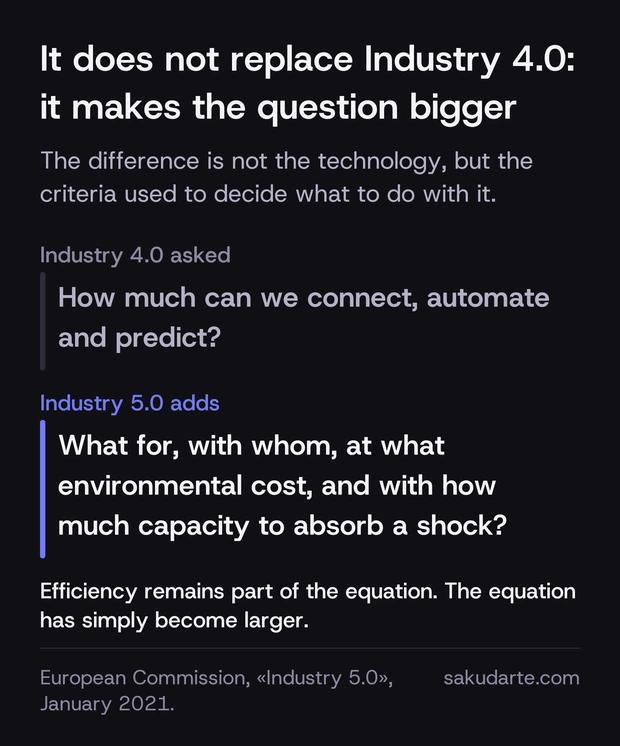
Put another way, Industry 4.0 helped us ask how we could connect, automate and make production systems more intelligent. Industry 5.0 introduces an additional question: what do we want to use all that technological capability for, and what kind of industry do we want to build with it?
The difference may seem subtle, but it changes the conversation considerably.
What is Industry 4.0?
Industry 4.0 describes the integration of digital technologies into industrial processes to create connected production systems capable of collecting information, exchanging data, analysing what is happening and responding increasingly intelligently.
Industrial Internet of Things, automation, robotics, artificial intelligence, advanced analytics, digital twins, cloud computing and cyber-physical systems all form part of this ecosystem.
The main difference from earlier stages of automation lies in connectivity.
An automated machine can perform a task without human intervention. A machine integrated into an Industry 4.0 environment can also report on its condition, detect deviations, share data with other systems, help anticipate a failure or modify certain parameters according to what is happening elsewhere in the process.
And that flow of information does not have to remain inside the factory.
It can connect production with maintenance, quality, logistics, engineering, suppliers, planning and market demand.
That is why reducing Industry 4.0 to “adding robots” leaves out much of what makes it interesting. The deeper change lies in connecting the physical and digital worlds around data and making that information useful for better decision-making.
What is Industry 5.0 and what does it add to Industry 4.0?
In January 2021, the European Commission presented Industry 5.0 as an evolution of an industrial vision focused primarily on efficiency and productivity.
It builds on Industry 4.0 while introducing three priorities: a human-centric, sustainable and resilient industry.
This matters because it broadens the definition of industrial success.
We can have a highly automated factory that is still extremely vulnerable to a supply disruption. We can improve productivity while creating roles that are increasingly difficult to fill because of skills shortages. We can generate enormous amounts of data without sufficiently reducing energy use, materials or waste.
Industry 5.0 does not reject efficiency. What it suggests is that efficiency alone is no longer enough to describe an industry that will remain competitive over the long term.
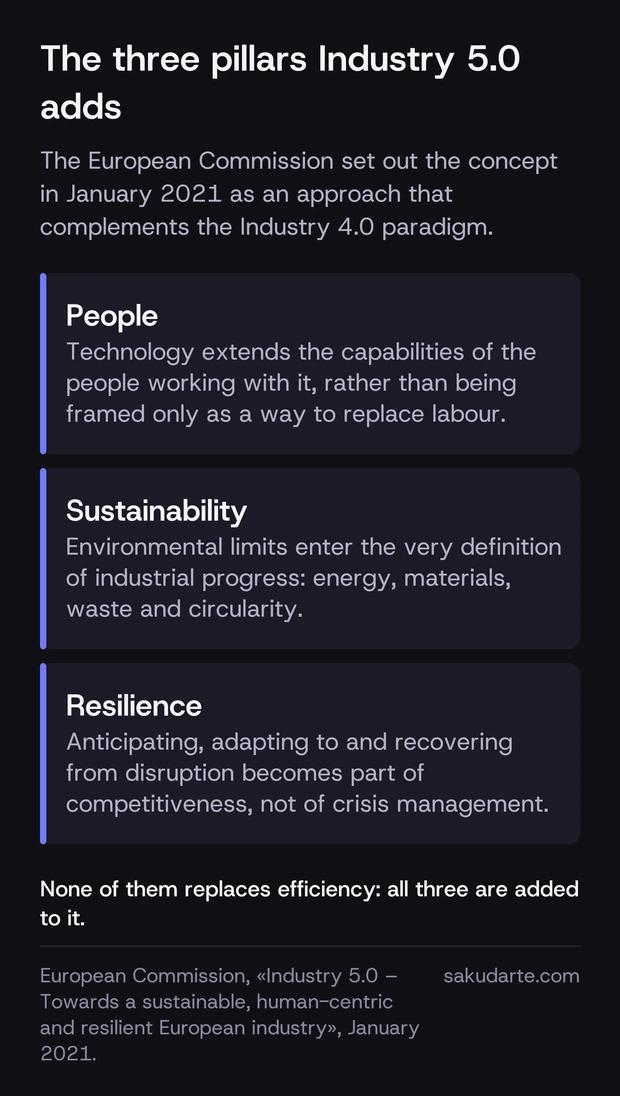
The European Commission frames this around three pillars.
A human-centric industry
Technology should enhance the capabilities of the people working with it rather than being considered exclusively as a way to replace labour.
That affects job design, training, ergonomics, safety, new skills and the relationship between people and intelligent systems.
The European roadmap on human-centric industrial research and innovation, published in July 2024, places skills development, wellbeing and employee participation at the centre of this transition.
A sustainable industry
Digitalisation can also be used to optimise energy consumption, materials, water, waste, emissions and circularity.
Not because every digital application is automatically sustainable, but because better data and greater control can help companies use resources more efficiently and understand the impact of their processes more clearly.
A resilient industry
Recent supply crises, energy volatility, shortages of certain materials and geopolitical tensions have added another word to the industrial vocabulary: resilience.
A company that is highly efficient under normal conditions can still face enormous difficulties if it depends on an extremely fragile supply chain.
Industry 5.0 therefore includes the ability to anticipate, adapt to and recover from disruptions as part of industrial competitiveness.
We are not replacing Industry 4.0 with Industry 5.0.
We are making the question bigger.
Technology still matters, but it is no longer the objective
None of this means that technology becomes less important.
Quite the opposite: IoT, AI, digital twins, robotics and data systems remain essential, but they are no longer justified simply because they are technologically interesting.
Industrial IoT: listening to what is happening in the factory
The Industrial Internet of Things (IIoT) connects machines, sensors, products and other devices to collect information about what is happening within a process.
Temperature, vibration, consumption, pressure, speed, operating cycles and the condition of particular components can all become data available to maintenance, production or quality teams.
A few years ago, obtaining that data already felt like a major achievement.
Today, the important question comes next: what decision are we going to make because of it?
Because measuring absolutely everything and changing nothing is a rather expensive way of watching the factory.
Artificial intelligence: from data to decisions
Artificial intelligence is expanding possibilities in predictive maintenance, quality control, planning, energy consumption, forecasting, design and anomaly detection.
And it is moving beyond isolated experimental projects.
In June 2026, the World Economic Forum announced that its Global Lighthouse Network had reached 238 recognised industrial sites, highlighting three trends among the most advanced companies: end-to-end integrated intelligence, collaboration between people and machines, and sustainability as part of operational performance.
The nuance is interesting.
We are no longer talking only about using AI to optimise an individual machine. The challenge is increasingly about incorporating it into the way organisations learn, make decisions and coordinate entire processes.
Digital twins: testing before changing reality
A digital twin creates a virtual representation of a machine, a process or even an entire facility using data from the physical world.
It can be used to simulate changes, study behaviour, compare scenarios or identify deviations between what should be happening and what is actually taking place.
In some environments, this means being able to test a change before accepting the cost and risk of applying it to the physical system.
Robotics: from replacing tasks to collaborating with people
Industrial robotics has been with us for decades, but its role is also changing.
Traditional robots are being joined by cobots, machine vision, autonomous systems and assistance tools capable of working alongside people or adapting more effectively to variations in their environment.
This is where the Industry 5.0 approach becomes particularly visible.
The question is no longer simply how many tasks we can automate. It also includes which combination of human and technological capabilities produces the best result.
A system can take on repetitive, dangerous or extremely precise work while a person contributes interpretation, adaptability and contextual knowledge.
It is not a particularly useful competition between humans and machines.
The interesting question is what the system formed by both can do better.
From automating people to augmenting their capabilities
This is probably one of the most interesting conceptual changes introduced by Industry 5.0.
In some narratives around automation, people almost appeared to be a temporary problem that technology would eventually solve.
The factory of the future was imagined as empty, silent and perfectly autonomous.
Industrial reality is turning out to be considerably less cinematic.
Companies still need operators, technicians, engineers, maintenance professionals, data specialists and people capable of understanding what is happening when a system behaves in a way nobody anticipated.
Technology changes their tasks and the skills they need, but it does not remove the human element from production.
The European Commission argues precisely that industrial technologies should be developed from a human-centric perspective so that they support and empower workers rather than simply replacing them.
We can see this in very practical applications.
A maintenance technician can use a system that prioritises the machines with the highest probability of failure. An operator can receive context-sensitive instructions through digital tools. An engineer can use AI to explore design alternatives. A vision system can detect a defect that a person then interprets within the wider production process.
But making this work requires something less spectacular than an algorithm and far more difficult to buy off the shelf: training, trust and knowledge.
Industrial transformation is also a transformation of capabilities.
Productivity still matters, but it no longer tells the whole story
It has long been argued that every industrial revolution has always pursued the same objective: productivity.
There is a great deal of truth in that.
Mechanisation, electricity, automation and now digitalisation have all made it possible to produce more, produce better and use fewer resources.
And the improvements can still be enormous.
Among the cohort joining the Global Lighthouse Network in early 2025, the World Economic Forum recorded an average 53% improvement in labour productivity and a 26% reduction in conversion costs associated with different digital solutions. It also reported significant reductions in consumption, waste and emissions.
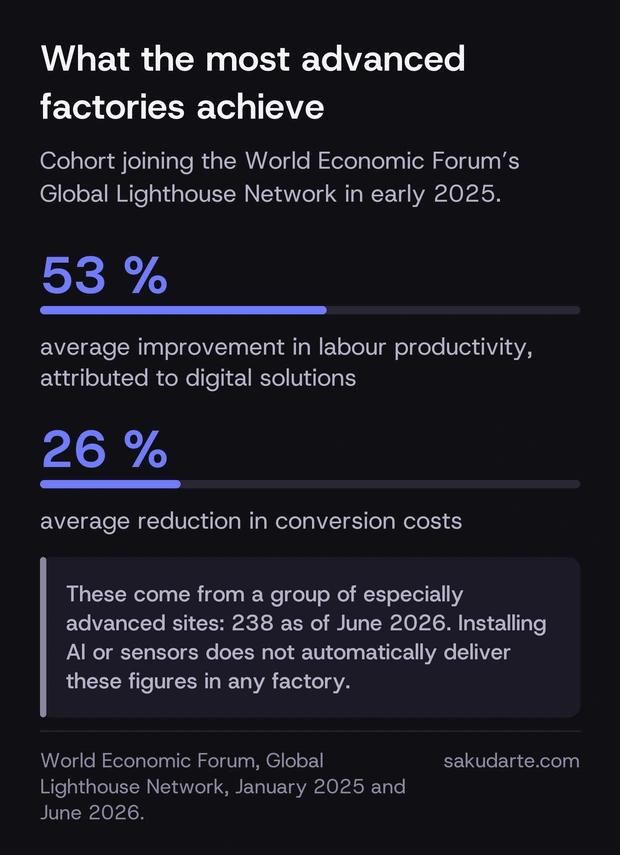
These figures should be read carefully. They do not mean that installing AI or sensors will automatically deliver those results in any factory. They come from a group of particularly advanced industrial sites.
But they demonstrate something important: productivity remains a central part of industrial transformation.
What has changed is that it is no longer alone.
The World Economic Forum does not evaluate its Lighthouse factories on productivity alone: it recognises outcomes across five dimensions — productivity, supply chain resilience, sustainability, customer centricity and talent — and has been doing so at least since the January 2025 cohort.
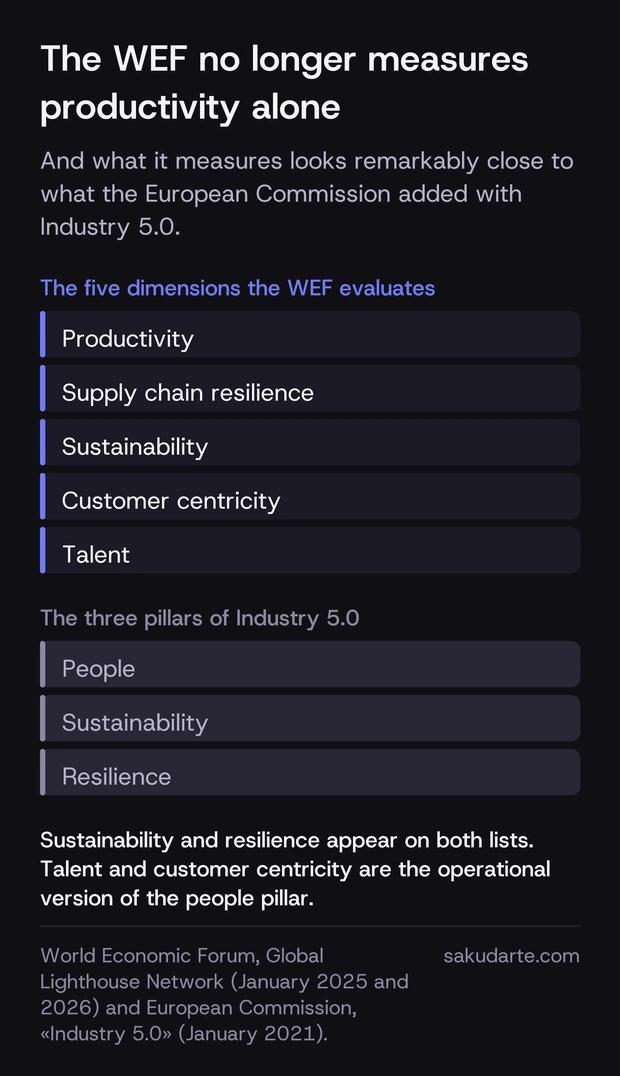
That looks remarkably similar to the conceptual evolution from Industry 4.0 towards Industry 5.0.
A competitive industrial company needs to produce well, but it also needs to respond when a supplier fails, attract people capable of working with new technologies, use resources more intelligently and adapt when the market changes.
Efficiency remains part of the equation.
The equation has simply become larger.
What opportunities does this evolution create for industrial companies?
The answer depends heavily on the company.
In one factory, the opportunity may lie in anticipating a critical failure and avoiding hours of downtime. In another, it may be reducing defects or energy consumption. One company may need greater flexibility to handle shorter production runs, while another wants to improve traceability or reduce the time required to launch new products.
Opportunities also appear outside production.
A manufacturer can use equipment data to offer predictive maintenance. A machine can evolve from being a purely physical product into a combination of hardware, software and services. Remote monitoring can transform the after-sales relationship. Usage data can help a company understand more clearly how customers actually work with its products.
This raises an issue that sometimes gets lost in discussions about Industry 4.0: digital transformation can also transform the business model.
It is not all about manufacturing the same thing at a lower cost.
We can manufacture differently, offer new services, personalise products, change the customer relationship or create revenue streams that did not exist before.
At that point, the project no longer belongs exclusively to production or IT.
It starts to affect strategy.
The challenges have changed too
The appealing side of Industry 4.0 tends to appear in demonstrations.
The difficult part arrives when we try to make everything work at scale.
One machine uses one protocol, another uses something different. The ERP has one naming system and the MES another. Some data is stored in cloud platforms, other data is on local servers, and a surprisingly large amount of critical information is still living in spreadsheets built years ago by someone who no longer works for the company.
That is where some of the real challenges appear.
Interoperability and data quality
Connecting systems creates value only if the data can be understood across them.
We need to know what each piece of data means, who maintains it, how often it is updated and which systems can rely on it.
The famous idea that “data is the new oil” has always seemed incomplete to us.
Unrefined oil is not particularly useful either.
Scaling beyond the pilot
Many companies manage to develop a good proof of concept and then discover that rolling it out across other lines, factories or countries is far more difficult.
The problem may be technological, but it can also be financial or organisational.
An isolated use case may depend on one particularly committed person, a very specific data set or a bespoke integration. Turning it into a repeatable capability requires standards, processes and governance.
The real leap is not having digital projects.
It is learning how to deploy them systematically.
Industrial cybersecurity
The more things we connect, the more things we need to protect.
And in a factory, the consequences of an incident can go far beyond losing information.
It can affect availability, quality, physical safety or production continuity.
That is why OT cybersecurity can no longer be treated as a final check at the end of a project. It needs to be part of the architecture and the decision-making from the beginning.
Talent and new skills
Another bottleneck is not inside any machine.
It lies in finding and developing people capable of working with these technologies.
A company may need data, automation, AI or cybersecurity specialists, but it also needs industrial professionals who understand technology well enough to identify where it can create value.
That combination of skills is not always easy to find.
This is probably one reason why Industry 5.0 places such emphasis on training, upskilling and reskilling. Technological transformation cannot depend entirely on bringing in outside specialists; some of the knowledge has to grow inside the organisation.
And what role does sustainability play?
For a while, digital transformation and sustainable transformation seemed like two separate conversations.
It increasingly makes little sense to treat them that way.
A system capable of measuring consumption in real time can help identify inefficiencies. Analytics can optimise processes that use large amounts of energy. Traceability can provide a better understanding of materials and life cycles. Digital twins allow alternatives to be assessed before physical resources are consumed.
But we should also avoid assuming that digitalisation automatically equals sustainability.
Technology infrastructure also consumes energy and materials. AI carries computational costs. Replacing equipment earlier than necessary to introduce new technology can create other impacts.
Sustainability appears when those capabilities are used for a specific purpose and the outcome is measured.
That is one of the most interesting contributions of Industry 5.0: bringing environmental limits into the very definition of industrial progress.
The question is no longer only how much we can produce with a given amount of resources.
We also start asking how we can reduce those resources, reuse them, replace them or design processes that are less vulnerable to scarcity.
If industry changes, the way we explain it has to change too
There is a curious phenomenon we see in many industrial companies.
The company has changed enormously on the inside, but it still communicates exactly as it did ten years ago.
It has introduced automation, develops software, connects equipment, offers remote monitoring, reduces consumption, works with data and sells new capabilities, yet when we visit its website we still find a photograph of a factory alongside three words: quality, innovation and commitment.
The gap between the real company and the company perceived by the market begins to grow.
And that gap matters more than it used to, because customers now research on their own long before they want to talk to anyone: it is one of the changes in industrial buying that have most transformed B2B marketing.
Industrial marketing has a very specific role here: turning complex capabilities into arguments that customers can understand and value.
This does not mean filling the website with terms such as smart, AI-powered, Industry 4.0 or Industry 5.0.
If the whole market uses the same words, we are still explaining very little.
It means explaining what changes for the customer.
If we use predictive maintenance, what problem can we prevent? If we have gained production flexibility, what kinds of orders can we now handle? If we have end-to-end traceability, what information does the customer receive? If a connected product enables remote monitoring, how does the after-sales service change?
Customers rarely buy “Industry 5.0”.
They buy less downtime, better quality, greater flexibility, lower risk, useful information or new possibilities.
That work almost always starts in the same place: the website, where customers research first, and where an industrial website has to explain products, applications and capabilities rather than simply introduce the company.
That is why B2B content marketing can be particularly valuable for companies transforming their offer: it allows technical knowledge, use cases and new capabilities to become information that the market can understand before a sales conversation begins.
How can we tell whether a company is really making progress?
Probably not by counting how many technologies appear in its corporate presentation.
It is more useful to look at what has actually changed in the way the organisation works.
Are we making better decisions because of data? Can we anticipate certain problems? Do systems exchange information or are we still rebuilding it manually? Have we reduced defects, consumption or lead times? Can we respond better when demand changes? Does a problem with one supplier bring us to a halt or do we have alternatives? Do new tools make people’s work easier, or have they simply added more screens?
And, above all, have we managed to take those improvements beyond the first pilot?
In January 2026, the World Economic Forum’s Global Lighthouse Network highlighted not only AI adoption but the ability to scale transformation from isolated use cases to entire networks, plants and value chains.
That may be one of the important differences between experimenting with Industry 4.0 and genuinely transforming a company.
The first can produce interesting projects.
The second changes the way the organisation works.
From Industry 4.0 to Industry 5.0: the question is no longer only how much we can automate
Productivity remains fundamental.
It would be rather strange to talk about the future of industry while ignoring cost, quality, capacity or efficiency.
But productivity no longer explains on its own where the conversation is heading.
Industry 4.0 gave us a language for talking about connected factories, data, automation, IoT, artificial intelligence and intelligent systems.
Industry 5.0 does not erase any of that.
It places it within a broader framework.
It asks whether those technologies can help us build companies that are less vulnerable, use resources more intelligently, develop the capabilities of the people who work in them and respond faster when circumstances change.
Perhaps the shift from Industry 4.0 to Industry 5.0 is easier to understand if we stop thinking in terms of generations of technology.
The question is no longer simply how much we can automate, connect or predict, but what kind of industry we want to build with all that capability.
A more productive industry, certainly, but also a less fragile one. More digital, but capable of developing the people who work within it. More efficient in its use of energy and materials. Better prepared to adapt when a supply chain breaks, new regulation appears or the market changes.
Technology remains an essential part of the engine.
What has changed is the criterion we use to decide where we want it to take us.
Sources
- European Commission, “Industry 5.0 – Towards a sustainable, human-centric and resilient European industry” (January 2021)
- European Commission: the three pillars of Industry 5.0
- European Commission, Industrial Technologies Roadmap on Human-Centric Research and Innovation (July 2024)
- World Economic Forum: the Global Lighthouse Network reaches 238 sites (June 2026)
- World Economic Forum: 53% labour productivity improvement and 26% reduction in conversion costs (January 2025)
- World Economic Forum: scaling transformation and the five dimensions (January 2026)