
B2B marketing automation: what to automate when the cycle takes months
In an industrial company the problem with marketing automation is almost never the tool: it is that the process takes months, several people decide it and it is written down nowhere. What can genuinely be automated, how much volume you need, and where to start without buying a platform.
What marketing automation is, and what it solves in B2B
Marketing automation means using software to run repeating tasks without manual intervention: sending a sequence of emails, alerting a salesperson when a contact returns to a particular page, moving someone from one list to another, recording what they did.
Put like that it sounds modest, and in part it is. Automation is not a strategy: it is a way of executing one.
The confusion starts when the tool is bought before there is anything to automate. That is the usual order, and it explains why so many licences end up being used as a rather expensive newsletter tool.
In an industrial company the problem is almost never the platform. It is that the process being automated takes months, several people decide it, and it is written down nowhere. Automating something nobody has described only makes it happen faster and with less judgement.
Marketing automation and sales automation are not the same thing
This is the first distinction worth making, because both get bought with the same sentence.
Marketing automation works with contacts that are not opportunities yet: it groups them, sends them information, records their behaviour and flags when something happens that deserves a call.
Sales automation works with opportunities that already exist: it creates the record, remembers the follow-up, updates the stage, prepares the quote, keeps a trace of the conversation.
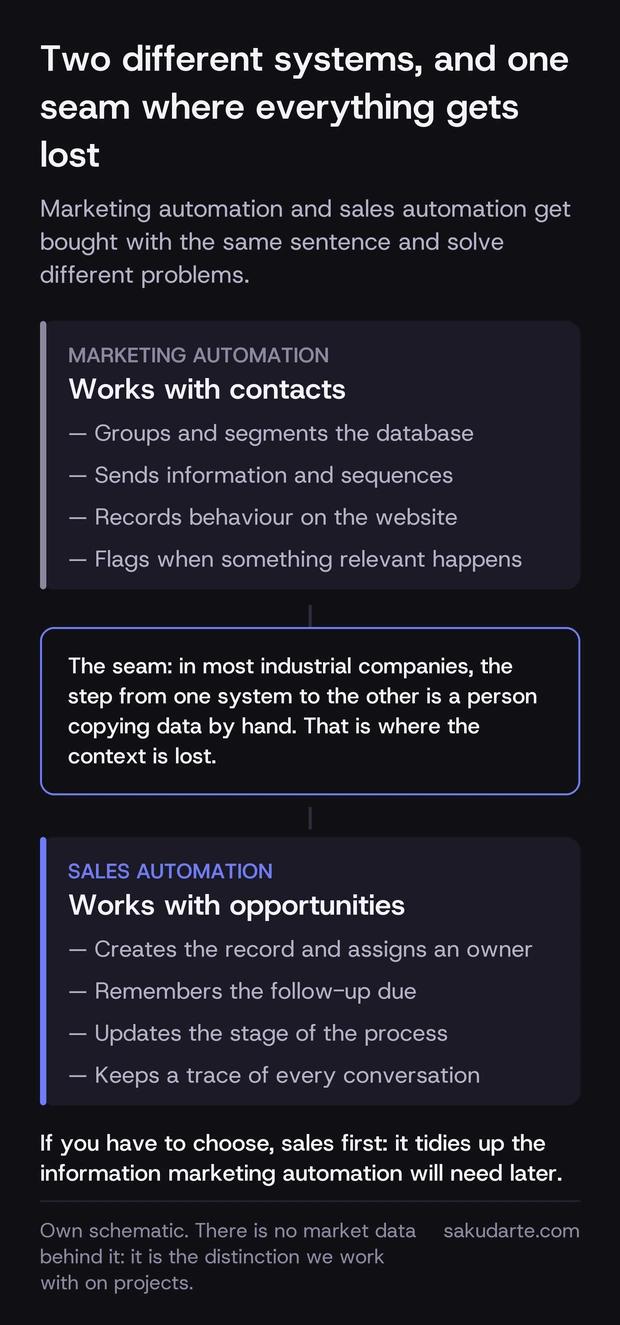
They are two different systems, and in most industrial companies the place where they meet is a person copying data from one to the other. That is where the context gets lost, and context is exactly what makes a contact useful in B2B.
If you have to choose where to start, sales automation is usually the better bet. It is less impressive, it affects fewer people, and it tidies up the information that marketing automation will need later.
Why automation behaves differently in industrial B2B
Three reasons, and none of them is technical.
The cycle is long. Months or years can pass between a first visit to the website and the order. A five-email sequence over two weeks does not accompany that process: it interrupts it five times and runs out long before the project is approved.
One person does not decide. An industrial purchase involves several functions —engineering, procurement, management, production— and each one asks a different question. We covered it in detail in 8 changes redefining how industry buys. Automating usually means talking to one of them, normally whoever left their email, who is rarely the one who signs.
The volume is small. A company handling thirty good enquiries a month does not have a scale problem: it has a follow-up problem. And follow-up is fixed sooner by a process and a tidy CRM than by an automation platform.
None of this takes value away from B2B marketing automation. It changes what you can ask of it: less «converting leads» and more not losing sight of somebody for fourteen months.
What can genuinely be automated in an industrial company
Of everything usually promised, this is what holds up:
- The record. Every enquiry landing in the CRM with its source, its company and what was asked, without anyone typing it. It is the dullest part and the one that pays best.
- The alert. The salesperson who owns an account knowing the same day that somebody from that company requested a data sheet.
- The delivery. Whoever downloads a document receiving it immediately, from a sender who is a person and not a mailbox.
- The internal reminder. An opportunity that has sat still for thirty days raising its hand, instead of waiting for the quarterly review.
- The reactivation. A project shelved a year ago coming back to the table when it should, because in industrial markets budgets come back.
And this is what rarely works the way it is sold:
- Long nurture sequences written for a single persona, when the reader is a committee.
- Automatic contact scoring used as the criterion for calling or not calling.
- Mass personalisation across a database of two hundred contacts, where writing by hand is cheaper and more credible.
Lead scoring: the problem with scoring clicks when a committee decides
Lead scoring assigns points for behaviour: visits, downloads, opens. Once a threshold is crossed, the contact is declared hot and handed to sales.
The mechanism makes sense when there are thousands of contacts and you need an order of play. With two hundred, what it adds is a false sense of objectivity.
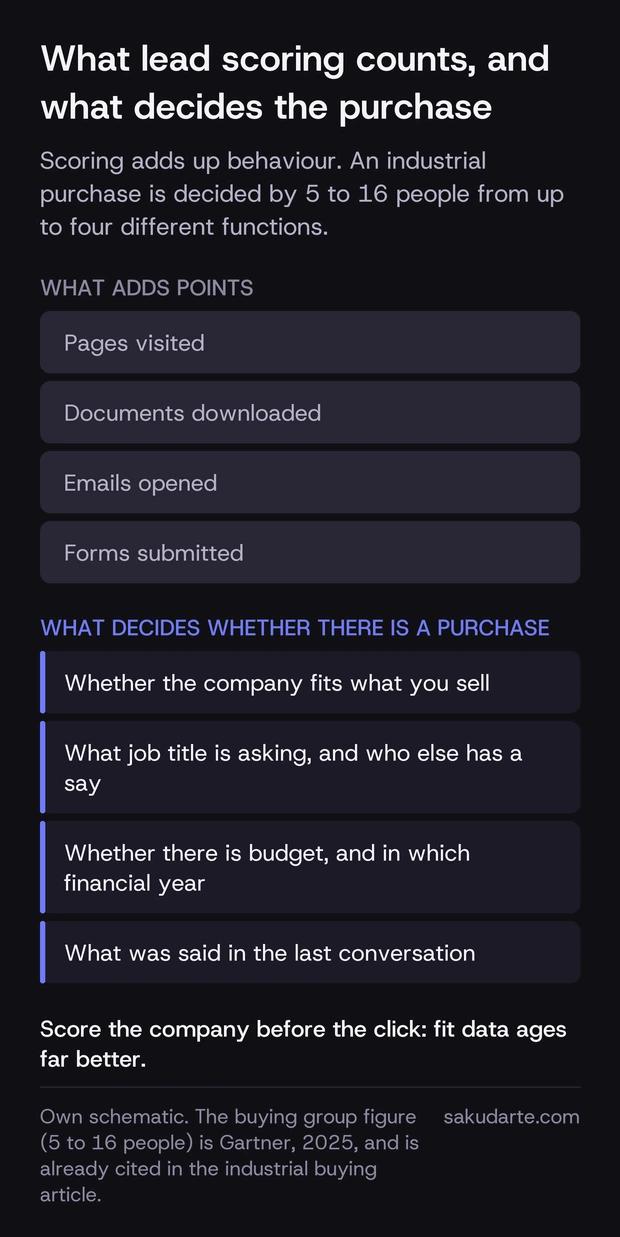
Somebody who visits three pages, downloads a catalogue and opens two emails may be an opportunity. They may also be a student, a competitor, a customer you already have, or an engineer running a very preliminary comparison who will not buy until next financial year.
We already wrote it in the article on the B2B conversion funnel: digital signals need context. The combination of company, job title, history and sales conversation says considerably more than the sum of the clicks.
Our practical recommendation: score the company —sector, size, whether it fits what you sell— before the behaviour. Fit data ages far better than a click.
The CRM is where automation almost always breaks
In most of the projects we review, the fault is not in the marketing platform. It is in the seam.
The symptoms are always the same: the website form creates a contact nobody assigns; the salesperson works from a notebook and the CRM gets filled in on Friday; the same company appears three times under three different names; nobody knows whether the last conversation was in March or in January.
With that underneath, automation amplifies the mess. A workflow firing on dirty data sends the wrong email to the wrong person, and leaves a record of it.
Before automating, three things are worth settling, and none of them needs new software: who owns each incoming enquiry, what exactly each stage of the process means, and where what was discussed gets written down.
How much volume you need before automating makes sense
This is the question almost nobody asks, and it decides everything else.
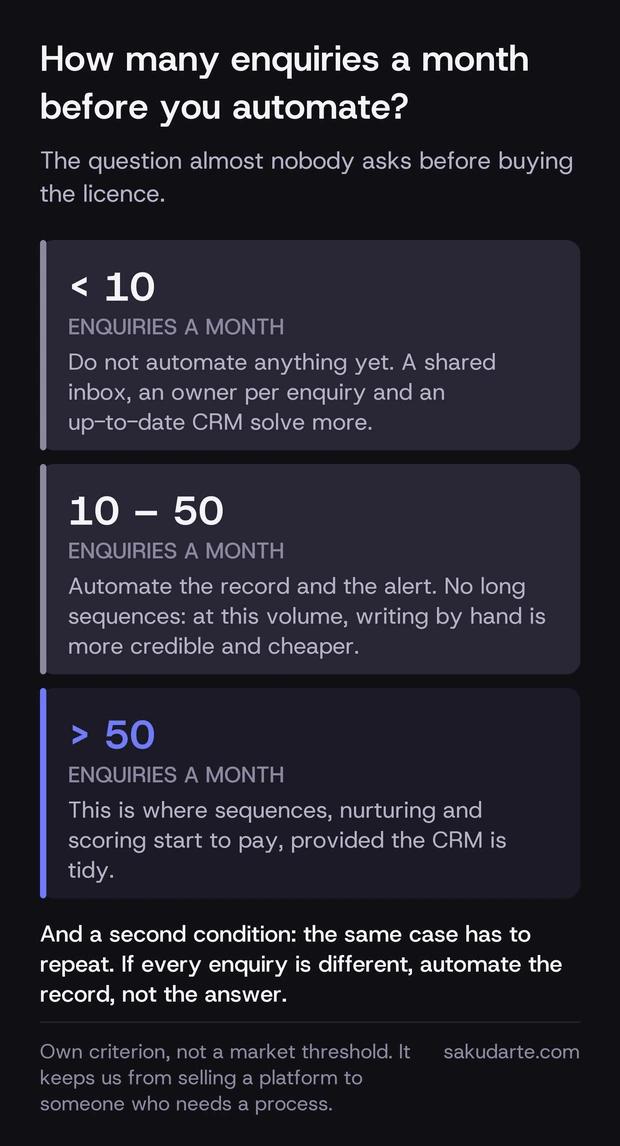
It is not a scientific threshold: it is the criterion we work with, and it exists to avoid selling a platform to someone who needs a process. At very low volumes, automation adds a maintenance layer that is paid for in time and not recovered in opportunities.
The other variable is repetition. A workflow deserves to exist if the same case comes up many times. If every enquiry is different —and in made-to-order manufacturing it is— what needs automating is the record and the alert, not the answer.
Where to start without buying a platform
An order that works:
- Write down the process as it is today, not as it should be: who receives an enquiry, what they do, how long it takes, where they note it.
- Tidy up the CRM you already have. Duplicates, stages, owner. There is almost always one, and it is almost always half done.
- Automate the record and the alert. Your form handler and your CRM are enough for this; no suite required.
- Add one sequence, only one, for the most repeated case you have identified. Measure it for three months.
- Only extend what you can maintain. A workflow nobody reviews turns into debt in under a year.
All of this sits inside a B2B marketing plan: automation is one of the execution phases, not the starting point. And it is part of what we work on under campaigns, social selling and automation.
What to measure to know whether it is working
The tool's own metrics —opens, clicks, contacts in the database— tell you the workflow is running, not that it is useful. Three questions that do tell you:
- How long does an enquiry take to get an answer from a person? If that falls, automation is doing its job.
- How many opportunities sit still without anyone noticing? If that falls, it has tidied up the follow-up.
- How many hours a month go into copying data between systems? If that does not fall, nothing has been automated: a tool has been added.
And a warning about timing: with buying cycles measured in months, no dashboard is going to prove the return on automation within a quarter. What it can prove within a quarter is that nobody is left without an answer and that no opportunity is lost to forgetfulness. In industrial B2B, that already pays for the work.
This article is part of our B2B campaigns.