
B2B Marketing Plan: phases to be found, considered and chosen
A B2B marketing plan turns strategy into priorities, assets, channels and concrete actions. We look at eight phases that help a company become easier to find, understand, consider and choose.
A B2B marketing plan can end up being a very reassuring document.
Objectives, actions, owners, channels, deadlines, KPIs. Everything neatly organised into columns, with a few colours to highlight priorities and that comforting feeling that we know exactly what we are going to do over the next twelve months.
The problem starts when the order of the document replaces judgement.
We can have a perfectly planned campaign aimed at a market that is not worth the effort, publish content for a customer segment that is not a priority or redesign a website before deciding what someone should actually understand when they get there.
That is why we believe a B2B marketing plan should begin well before the calendar.
Strategy decides where we want to compete, who we want to be relevant to and why they should consider us. The plan then turns those decisions into assets, channels, actions, responsibilities and ways of measuring progress.
That difference matters.
A strategy without execution remains an intention. A plan without strategy can turn into twelve months of doing things with impressive discipline and very little direction.
These are the eight phases we use to organise that move from decisions to market.
Before we start: strategy and plan are not the same thing
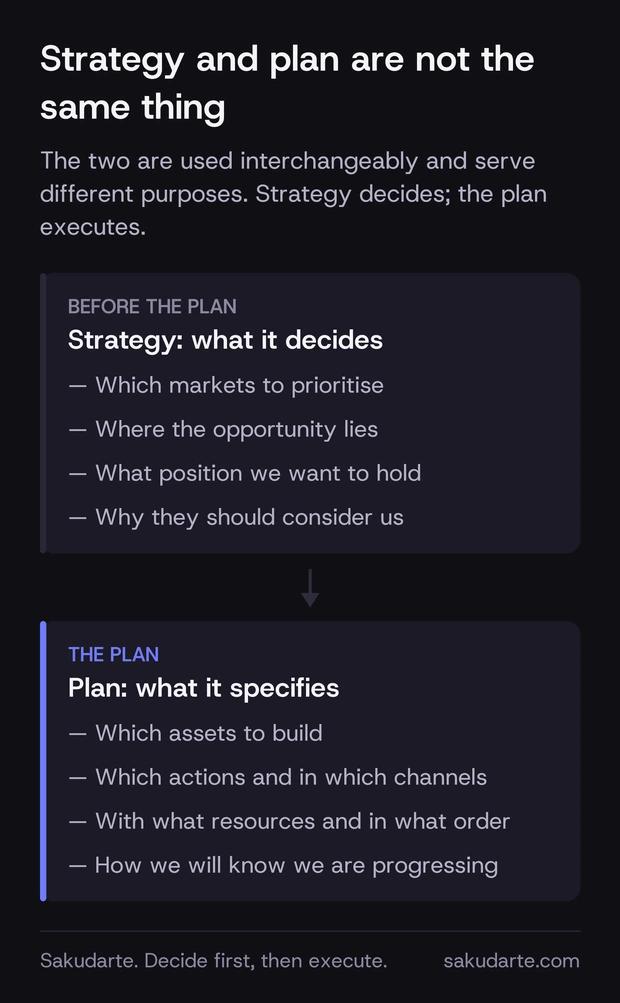
The two terms are often used as though they were interchangeable, but they serve different purposes.
Strategy answers questions such as which markets we want to prioritise, where the opportunity lies, what position we want to occupy or what makes our proposition relevant compared with other alternatives.
The plan goes one level deeper.
It decides what we need to build, what actions we are going to take, through which channels, with what resources, in what order and how we will know whether we are making progress.
That is precisely why both need to be connected. On our B2B marketing strategy page, we develop the thinking that should come before the plan: the decisions that need to be resolved before execution begins.
From there, the work covered in this article starts.
Phase 1. Understand who is actually involved in the decision
Before deciding what we are going to say, we need to know who ultimately has to believe it.
In B2B, there is rarely a single decision-maker. Technical teams, procurement, management, production or finance may all be involved in the same purchase with different priorities.
We will not go into how those buying groups work here because the topic deserves its own analysis. We cover it when looking at the changes in industrial buying.
For the purposes of the plan, one question is enough: do we know what each person involved needs in order to consider, defend or approve our proposition?
If we cannot answer that yet, it is still too early to decide on content and actions.
Phase 2. Define what we want the market to understand about us
Once we know who we want to reach, an apparently simple question appears:
Why should they consider us?
Not why we are good, experienced or committed to quality. Their other potential suppliers will probably say exactly the same.
We need to define what we want someone to understand about our company and what real reasons they have to include us among the options worth considering.
This is where positioning, value proposition and message architecture come in.
And they come before channels for a very practical reason: increasing the visibility of a confusing proposition does not solve the confusion. It simply exposes more people to it.
A company can invest in SEO, LinkedIn or advertising and then discover that, when a potential customer arrives, they see the same messages they would find on any competitor's website.
«Innovative solutions». «Quality and commitment». «More than thirty years at your service».
All of that may well be true.
But if we want to be chosen, we also need to find what is specific, relevant and demonstrable in our case.
The plan starts to gain direction when we know what we want the market to remember.
Phase 3. Build the assets that support the decision
Once the strategy and messaging are clear, we can start building.
And this is where the conversation is often reduced too quickly to «we need a new website».
The website is fundamental, but it is not alone.
Brand, product or service pages, case studies, content, presentations, technical documentation, photography, video, product sheets, sales tools or distributor materials all form part of the same system.
The mix will be different for every company.
A manufacturer with thousands of product references needs a different infrastructure from an engineering business delivering fifteen large projects a year. A company looking to internationalise may need a web architecture, content and sales tools designed specifically for markets where it is still relatively unknown.
The useful question is not how many assets we can produce.
It is what a customer needs to find in order to understand the proposition and what sales needs in order to continue the conversation.
An industrial website should allow customers to investigate capabilities, solutions and experience without forcing them to request a meeting just to understand the basics. B2B content marketing can then develop the questions that require more depth and turn internal knowledge into arguments that can be used throughout the decision process.
Assets create value when they form part of the same story.
Not when each one starts again from scratch.
Phase 4. Build visibility where it actually matters
Once we have something clear to say and assets capable of supporting it, we can start generating visibility.
SEO, search engines, AI tools, LinkedIn, advertising, trade media, events, email, associations, distributors, referrals.
The list can become very long.
The plan does not improve as we add more channels.
It improves when we know where it is worth showing up.
For an industrial company, a highly specific search made by twenty relevant people in the market can be worth more than thousands of impressions from profiles that could never become customers. A campaign aimed at fifty priority accounts may be more valuable than one producing huge reach figures.
That is why an industrial marketing plan needs a clear view of the market: countries, sectors, types of company, applications, roles or accounts where resources should be concentrated.
We also need to think about how research behaviour is changing. Buyers no longer discover suppliers only through traditional search; they may consult AI tools, recommendations, specialist content or several different sources before visiting our website.
That creates more entry points, but it does not change the underlying question:
Are we present when the market is trying to solve a problem for which we can be relevant?
We do not need to be everywhere.
We need to avoid being absent from the places that matter.
Phase 5. Make it easy for interest to move forward
A visit is not an opportunity.
And an email address is not one either.
For years, much of digital marketing was organised around a very specific idea of conversion: offer a PDF, ask for contact details and start a follow-up sequence.
In some cases, that still makes sense. In others, placing a form in front of every piece of content simply adds friction.
The next step depends on the stage and the nature of the purchase.
An engineer may need a technical datasheet. Someone in procurement may want to check certifications. A person who already knows the solution may be ready to request a meeting, while someone else simply needs to review a similar case before adding us to an initial shortlist.
A good plan should identify those possible next steps and make them easy.
Conversion is not about capturing data at any cost.
It is about making it easier for an opportunity to keep moving when it is ready to do so.
In our article on the B2B conversion funnel, we look in more detail at why that movement rarely happens in a straight line and how to use the funnel without confusing our measurement model with actual buyer behaviour.
Here, one practical consequence is enough: we should not design the plan assuming that everyone will arrive, download something, receive four emails and request a meeting in that order.
Phase 6. Connect marketing and sales around the same process
Marketing and sales have different departments, tools and internal objectives.
The customer does not need to notice.
For them, the website, an article, a LinkedIn conversation, a sales presentation, a trade show meeting and the proposal they receive afterwards all belong to the same company.
That is why the plan should define how information flows between both teams.
Marketing needs to understand the questions that appear in meetings, the objections that block opportunities, the competitors that come up repeatedly and the materials sales is missing.
Sales, in turn, should know what the company is communicating, which content it can use and what signals the market is generating.
We do not need to revisit here how buyer behaviour has changed, which is what the changes in industrial buying are about. The implication for the plan is what matters: marketing and sales can no longer operate as two independent stages that simply pass a lead from one to the other.
They have to contribute to the same decision from different moments.
When that coordination exists, commercial data also starts improving marketing. We learn which sectors convert better, which messages work in real conversations or why a proposition that looked excellent on paper fails to move forward.
The market gives information back.
The plan needs to be designed to listen.
Phase 7. Decide what is actually worth automating
Automation can save a huge amount of work and make follow-up more consistent.
It can also help us send the wrong message with extraordinary efficiency.
That is why this phase starts with a question, not a tool:
Which parts of the process are repetitive, predictable and useful enough to automate without making the experience worse?
Follow-ups, information classification, certain communications, alerts, data updates or internal tasks can benefit greatly from automation and AI.
The subject deserves its own article, because deciding what to automate and what should still depend on human judgement is becoming an increasingly important part of modern B2B marketing.
For now, the plan only needs to define where that opportunity exists and what objective it should serve. The tool comes later.
Phase 8. Measure enough to make another decision
A marketing plan needs KPIs.
Not because dashboards look impressive, but because at some point we will have to decide whether to continue, change or stop doing something.
And for that, we need information.
Visibility, search demand, qualified traffic, engagement or downloads can help evaluate certain stages. Closer to the business, we have enquiries, opportunities created, meetings, proposals, sales progression, pipeline, revenue or repeat business.
Not every company needs to measure exactly the same things.
But they should progressively be able to connect marketing activity with what happens afterwards.
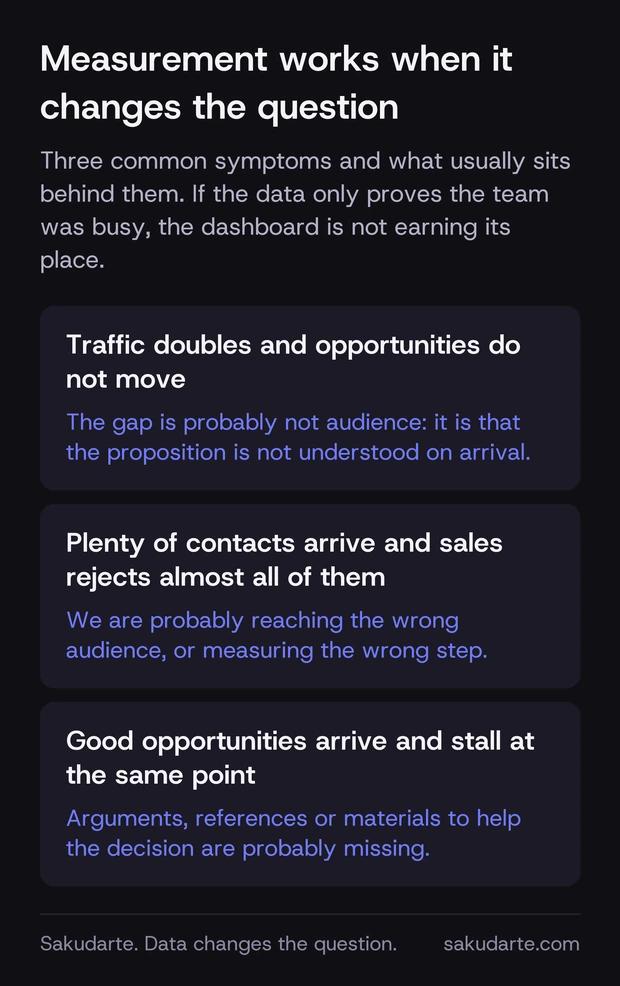
Imagine that we double traffic and opportunities do not move. Perhaps the problem is not attracting more people.
Or we generate lots of contacts and sales rejects most of them. Maybe we are reaching the wrong audience.
It may also happen that good opportunities enter the pipeline but are repeatedly lost at similar points in the commercial process. In that case, we may need better arguments, references or materials to help the decision move forward.
Measurement is useful when it changes our understanding of the problem.
If data only serves to prove that the team has been busy, we are using a very powerful tool for a surprisingly modest purpose.
That is why a plan should not be written once a year and left untouched until December.
It needs to be able to learn.
After the first sale, the plan continues
In many B2B businesses, a first deal can be the beginning of a relationship lasting years.
A satisfied customer may buy again, add other product lines, expand services, introduce us to other plants or recommend us elsewhere in the organisation.
And it can also become something especially valuable for attracting new customers: proof.
That is why case studies, references, follow-up, customer content, training, product updates and listening should all form part of the plan.
Some companies invest enormous amounts of energy in winning an account and then almost stop marketing to it once they have succeeded.
That seems strange when we consider the potential value of a B2B relationship.
A real customer also answers a question that no corporate claim can answer with the same credibility: has a company like ours already trusted this supplier?
Our B2B marketing case studies are useful for exactly that reason. They do not only show what we have done; they allow another company to recognise itself in a problem, context or decision that someone else has already faced.
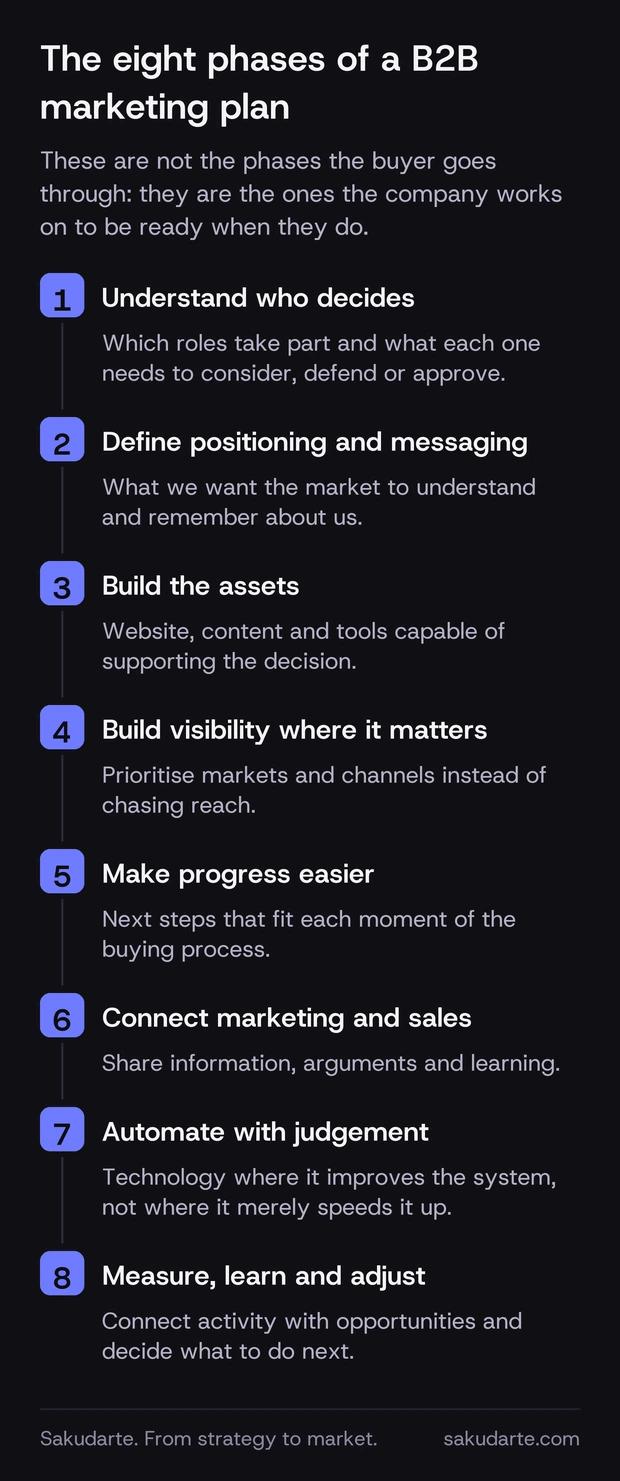
The 8 phases of a B2B marketing plan
If we had to condense everything above, the plan would look like this:
- Understand who is involved in the decision. Know which roles take part and what each one needs to move forward.
- Define positioning and messaging. Clarify what we want the market to understand and remember.
- Build the necessary assets. Website, content and tools capable of supporting the decision.
- Generate visibility where it matters. Prioritise markets and channels rather than chasing reach for its own sake.
- Make progress easier. Design appropriate next steps for different moments in the buying process.
- Connect marketing and sales. Share information, arguments and learning.
- Automate with judgement. Use technology where it genuinely improves the system.
- Measure, learn and adjust. Connect activity with opportunities and use data to decide what to do next.
These are the phases of the plan.
Not the phases we expect the customer to obediently follow.
That distinction is probably one of the most important things to preserve when building it.
In our B2B marketing system, we group this logic into three broad stages: Strategy, Build and Activation. First we make the decisions that create focus, then we build the assets we need and finally we take them to market, measure and learn.
A plan turns that logic into concrete work. Actions. Owners. Priorities. Deadlines. Channels. Assets. Metrics.
But the document is not the objective.
The objective is to make sure that, when a company starts looking for a solution like ours, it can find us, understand why we are relevant, gather enough evidence to consider us and, when the time comes, choose us.
Everything else is just another cell in the spreadsheet.
This article is part of our B2B marketing strategy.